Blinding reign
(Pouring poor)
The rule of man
(Command of the fool)
[Outro]
Burning their house down
(Down, down, down)
Surprise!
(Hitting ya in the eyes)
Blinding
(Reign, rain)
Pouring
(Poor poor)
See the scene seen?
About the Song
What happens to you over the next five years?
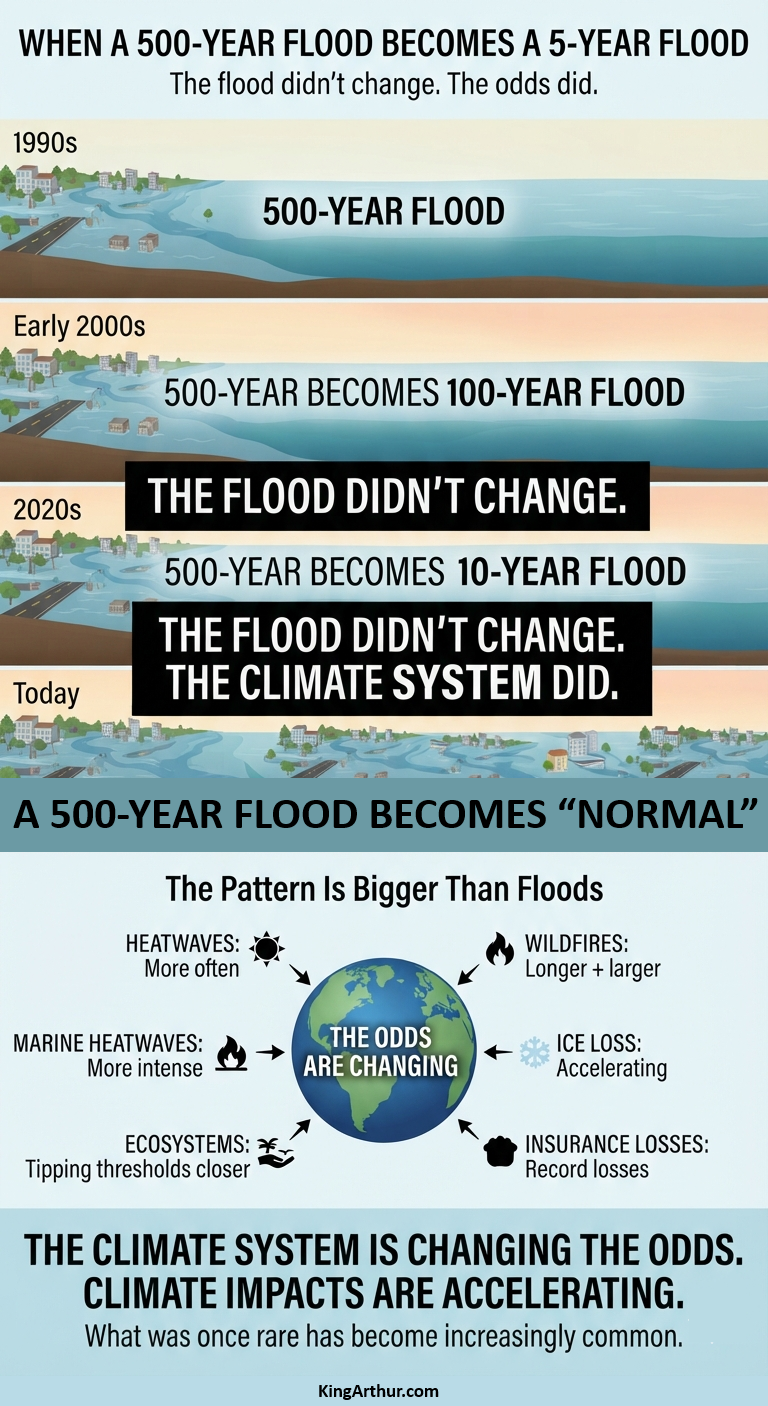
We are already seeing rainfall becoming more intense and, in many places, more destructive—violent. A warmer atmosphere can hold more water vapor, increasing the potential for extreme precipitation. The question isn’t simply how hot the planet might become over the next 50 years.
The more immediate question is:
What is the violent rain going to do to your home, your community, your infrastructure, your insurance—and you—over the next five years?
That is where climate change stops being a distant projection and starts becoming a personal reality.
Welcome to the future. Climate change is accelerating—and the acceleration itself is accelerating.
Many people equate global warming solely with increasing temperatures. This is a deadly misunderstanding. The additional energy accumulating within Earth’s climate system does not remain simply as heat. It is redistributed throughout the atmosphere and oceans, manifesting in many forms of extreme weather, including floods, stronger storms, atmospheric rivers, and increasingly destructive episodes of violent rain.
Violent rain is not merely heavier rainfall. It is rainfall intensified by the additional energy and moisture now present in the climate system, producing larger raindrops, higher rainfall rates, more intense runoff, and more destructive flooding and erosion.
As the Earth warms, warmer air can physically hold more water vapor than cooler air. For every 1°C (1.8°F) increase in temperature, the atmosphere can hold approximately 7% more moisture, increasing the potential for extreme precipitation. Over a 10°C increase, atmospheric moisture capacity nearly doubles, dramatically amplifying the intensity and frequency of heavy rainfall events.
About the Song
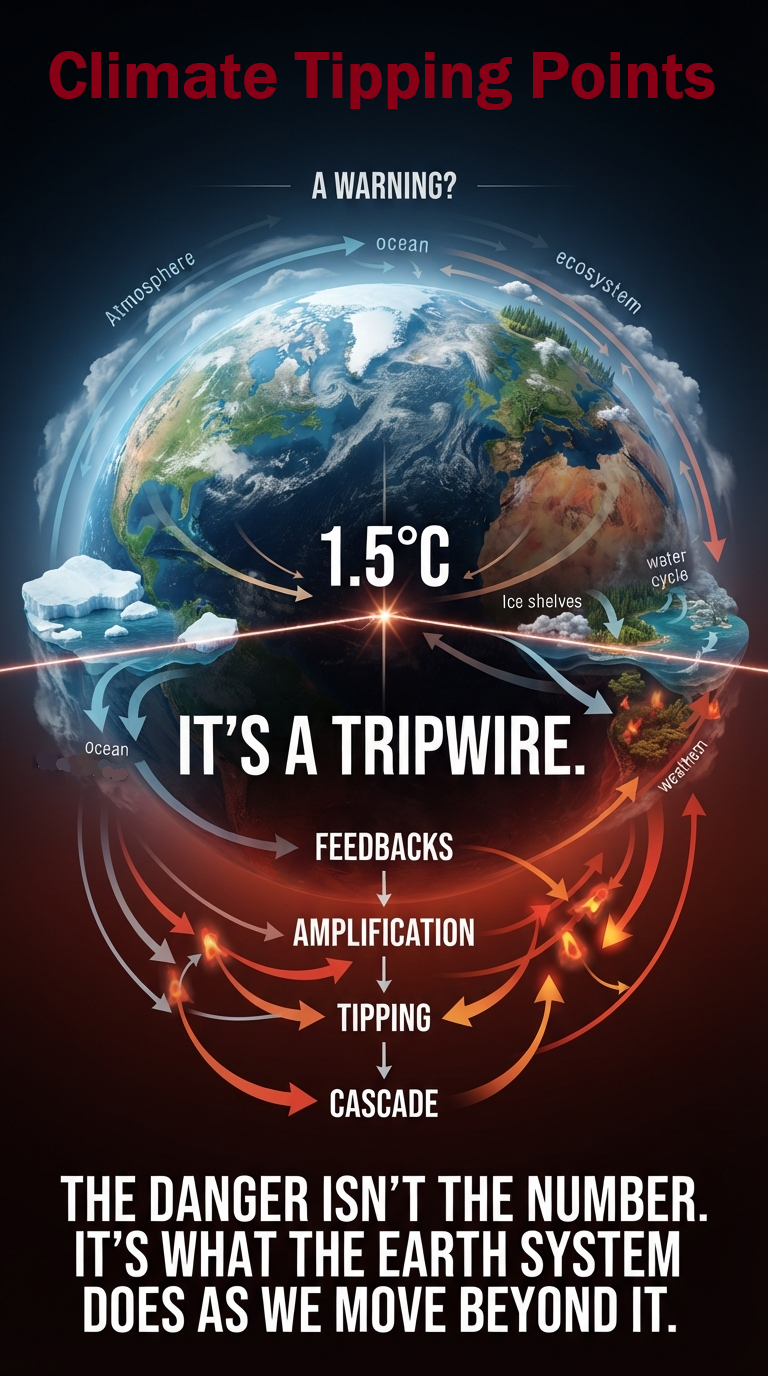
The 1.5°C threshold identified in the Paris Agreement—and the roughly 2°C level generally regarded as an even more dangerous boundary—is not important because the difference between 1.4°C and 1.5°C is somehow magical. These numbers matter because increasing global temperatures raise the probability of triggering major climate tipping points.
And once tipping points begin to activate, the question of whether warming ultimately reaches 2°C, 3°C, or even 4–7°C becomes much less relevant for two fundamental reasons:
First, tipping points can initiate self-reinforcing feedbacks that continue driving change even after the original forcing changes.
Second, the impacts do not necessarily increase gradually with temperature. They can accelerate, compound, and cascade as interconnected systems begin to destabilize.
In other words, 1.5°C is not a destination. It is not merely a warning sign or an alarm. It is a tripwire.
[Intro]
Feedback loop and tipping-point network: it starts at the top of the world… and works its way down to Middle Earth, where our girth is actually slowing the planet’s rotation. Welcome to the present.
Starting at the top…
(Top of the world)
Place is changing…
(Things are rearranging)
Down from the poles…
(Into the whole)
A little change
(Becomes something strange)
[Verse 1]
Up where the cold wind blows
(Where the white world glows)
Ice is losing ground
(And the heat comes round)
Pole to pole
(Losing control)
The gradient weakens
(The system awakens)
Difference gets smaller
(The feedback gets taller)
[Pre-Chorus]
Move the mass
(Change the spin)
One more coupling
(Let it begin)
[Refrain]
Starting on top of the world
(Coming unfurled)
Working down to the middle
(Creating an existential riddle)
Are you slowing down
(Spinning round)
Down, down, down
(Hey! Hey! Hey!)
Changing the time of day
[Verse 2]
The equator
(The pole)
Used to have a different role
(For sure)
Hot and cold
(High and low)
Set the gradient
(Watch it go)
That old difference
(Doesn’t last)
Energy moves
(Into different grooves)
And down below
(Feel the water flow)
[Refrain]
Starting on top of the world
(Coming unfurled)
Working down to the middle
(Creating an existential riddle)
Are you slowing down
(Spinning round)
Down, down, down
(Hey! Hey! Hey!)
Changing the time of day
[Verse 3]
Welcome to Middle Earth
(What’s that really worth?)
Our girth
(Has some worth)
Shift the distribution
(Change the rotation)
Tiny little change
The system’s sure strange)
Begin!
(Spin!)
Mass!
(Fast!)
Move!
(Prove!)
Time!
(And time again!)
Top of the world!
(Down to the middle!)
Top of the world!
(Down to the middle!)
[Verse 4]
Atomic clocks
(Watch the rocks)
Earth rotation
(Observation)
A tiny variation
(In the rotation)
Becomes information
(About the whole system)
[Bridge]
One system…
(Many parts)
One pulse…
(Many hearts)
Mass…
(Spin…)
Time…
(Begin!)
A change up there
(Travels down here)
A change over there
(Alter what’s near)
[Refrain]
Starting on top of the world
(Coming unfurled)
Working down to the middle
(Creating an existential riddle)
Are you slowing down
(Spinning round)
Down, down, down
(Hey! Hey! Hey!)
Changing the time of day
Starting on top of the world
(Coming unfurled)
Working down to the middle
(Find a piece of the riddle)
Are you slowing down
(Spinning round)
Down, down, down
(Hey! Hey! Hey!)
Changing the time of day
[Final Refrain]
Starting on top of the world
(Coming unfurled)
Working down to the middle
(Creating an existential riddle)
[Outro]
Are you slowing down
(Spinning round)
Down, down, down
(Hey! Hey! Hey!)
Changing the time of day
Starting at the top…
(Down to the middle)
Feedback coupling…
(It’s all connected)
Round and round…
(The network’s turning)
Day by day…
(Time keeps changing)
Round and round…
(Down, down, down…)
Hey! Hey! Hey!
(The time of day)
About the Song
Feedback loop and tipping-point network: it starts at the top of the world… and works its way down to Middle Earth, where our girth is actually slowing the planet’s rotation. Welcome to the present.
Polar amplification → weakened equator-to-pole temperature gradients → planetary mass redistribution → altered moment of inertia → rotational dynamics → slight rotational slowing → changes in length of day.
About the Song
Feedback loop and tipping-point network: it starts at the top of the world… and works its way down to Middle Earth, where our girth is actually slowing the planet’s rotation. Welcome to the present.
Polar amplification → weakened equator-to-pole temperature gradients → planetary mass redistribution → altered moment of inertia → rotational dynamics → slight rotational slowing → changes in length of day.
Today’s new release, “Feedback Network,” is also tonight’s homework assignment: create a theme-song sound for the next eco-rock album, “Feedback Coupling.”
The song is about a remarkably strange consequence of climate change: humanity is, in a very literal sense, changing the length of the day.
As polar ice melts and mass is redistributed through the Earth system, the planet’s rotation can change slightly. The effect is tiny—but measurable, and large enough to create challenges for keeping highly precise time in scientific and technical applications.
It’s a little like the Y2K problem of 1999. Y2K involved a seemingly tiny detail in computer code—the way years were represented—that became important because modern systems depended on precise timekeeping.
This is different, of course. Here, the problem isn’t a coding convention. It’s the Earth itself changing how it rotates.
And that matters for systems that depend on extremely precise timing and positioning—particularly GPS and other satellite-based technologies.
The irony is pretty remarkable:
We changed the climate.
The climate changed the planet.
And now we’re having to account for the change in the clock.
This song is my attempt to translate that feedback network into sound.
It’s experimental audio science.
The track begins with a clean acoustic/electric guitar signal, running through a digital delay and distortion pedal. The guitar starts relatively clean and acoustic. Then the distortion enters, followed by increasing digital-delay feedback.
Next, a live synthesizer joins the network.
Again, the signal begins clean.
Then it becomes distorted.
Then delayed.
Then the delay feeds back into itself.
And the guitar and synth begin interacting as a coupled system.
The musical system starts behaving a little like the climate system I’m trying to describe: one change feeds into another, which feeds back into the first, creating something larger and increasingly complex.
By the end, we’ve arrived at some serious feedback coupling.
[Verse 1]
High above the valley
(Where the sky flies by)
Something’s disappearing
(Right before our eyes)
Five years gone
(Nineteen point four)
Ice keeps melting
(More and more)
[Refrain]
Yelps!
(From the Swiss Alps)
Hot as hell…
(Fare thee well?)
When the mountains crumble
(Left with a pile of rubble)
No use crying… no use to mumble
(Trouble coming is about to double)
[Verse 2]
Two and a half meters
(Three or four!)
Gone, gone, gone
(And maybe more)
Ten meters vanished
(Where did they go?)
Thirty-three feet
(Down below)
Aletsch!
(Allalin!)
Clariden!
(Rhône!)
[Refrain]
Yelps!
(From the Swiss Alps)
Hot as hell…
(Fare thee well?)
When the mountains crumble
(Left with a pile of rubble)
No use crying… no use to mumble
(Trouble coming is about to double)
[Bridge]
Matterhorn…
Wind torn
(Where did the snow go…?)
Take stock…
(Bare rock…)
Frozen ground…
(Coming down…)
[Bridge 2]
Lose the glacier…
(Are you sure…)
… we’ll endure?
And the system changes us!
(Dangerous!)
Oh, well!
(Fare thee well!)
More energy!
(More melt!)
More melt!
(Danger felt!)
[Final Refrain]
Yelps!
(From the Swiss Alps)
Hot as hell…
(Fare thee well?)
[Outro]
When the mountains crumble
(Left with a pile of rubble)
No use crying… no use to mumble
(Trouble coming is about to double)
Yelps!
(From the Swiss Alps)
Hear that bell…
(Fare thee well?)
When the frozen foundations
(Start to crumble)
Every little warning
(Becomes a rumble)
What the hell?
…fare thee well…
About the Song
How Is the Climate Energy Hitting You?
Swiss Alps: Fare Thee Well?
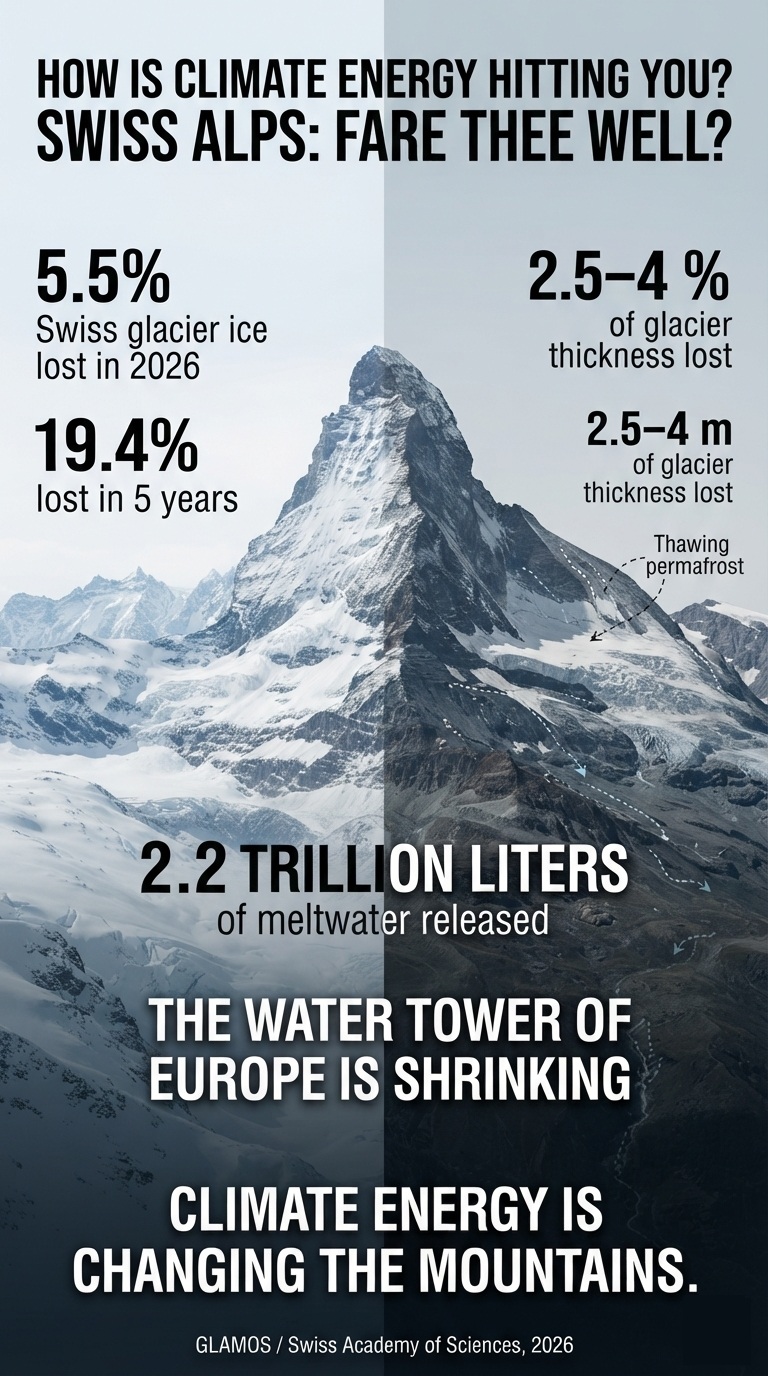
Swiss glaciers are disappearing at an extraordinary rate.
The Glacier Monitoring in Switzerland (GLAMOS) network and the Swiss Academy of Sciences report that Swiss glaciers lost approximately 5.5% of their total ice volume during the first eight months of 2026. That is the second-largest annual percentage loss on record, exceeded only by the exceptional melt of 2022.
The combination of exceptionally low winter snowfall and a record-hot summer has pushed Alpine glaciers into increasingly dangerous territory. Scientists warn that continued warming threatens the long-term survival of many Swiss glaciers.
A Five-Year Avalanche of Ice Loss
The latest measurements reveal how rapidly Switzerland’s frozen water reservoir is shrinking.
Nearly 20% Gone in Five Years
Swiss glaciers have lost approximately 19.4% of their ice mass in just five years.
Percentage Losses Are Accelerating
Although the absolute volume of ice lost in 2026 was lower than during the infamous 2003 heatwave, the percentage loss was substantially greater. The reason is straightforward: Switzerland’s remaining glacier ice reservoir is now dramatically smaller than it was two decades ago.
Meters of Ice Disappearing
Glacier thickness declined by roughly 2.5 to 4 meters (8 to 13 feet) in many areas during 2026, while some glacier tongues retreated by as much as 10 meters (33 feet). Major glaciers, including the Allalin, Clariden, Rhône and Aletsch, experienced severe melting.
The implication is important: as glaciers become smaller, a similar amount of atmospheric heat can produce an increasingly large percentage reduction in the remaining ice.
When the Mountains Begin to Crumble
The damage is not limited to the glaciers themselves.
Extreme warmth is also destabilizing the high Alpine environment by thawing permafrost—the permanently frozen ground and rock that helps stabilize steep mountain slopes.
Bare High Peaks
By late September 2026, the Matterhorn, rising 4,478 meters (14,692 feet), was photographed with exceptionally little snow cover. Persistent snow and ice at high elevations are becoming increasingly vulnerable during extreme warm periods.
Thawing Permafrost
As permafrost thaws, meltwater can penetrate cracks and fractures in mountain rock. The resulting changes in water pressure, ice bonding and rock strength can increase the risk of rockfalls, landslides and other slope failures.
In some locations, exceptionally rapid ground movement has already been observed. At sites such as Spitzerstein above Kandersteg, slopes have reportedly shifted by as much as 70 centimeters per day, demonstrating how quickly Alpine terrain can respond when its frozen foundations deteriorate.
The loss of glacier ice therefore represents more than a change in scenery. It is a change in the physical infrastructure of the European water cycle.
Climate Energy at Work
Glacier loss provides one of the clearest visible examples of how excess climate energy is redistributed through the Earth system.
More atmospheric and oceanic energy → warmer air → reduced snowfall → accelerated glacier melt → exposed darker surfaces → greater solar absorption → further ice loss
At the same time:
Warming → permafrost thaw → weaker mountain structures → increased rockfall and landslide risk
These are not isolated events. They are interacting components of a changing climate system.
The Swiss Alps are effectively losing part of their natural infrastructure in real time.
Fare Thee Well?
Some small, low-elevation Alpine glaciers may already be committed to disappearance under present climate conditions. But the larger question extends far beyond Switzerland.
Every fraction of a degree of additional warming affects glaciers, snowpack, permafrost, water supplies and sea-level rise. The loss of a glacier is therefore not simply the loss of ice. It is the loss of a natural reservoir, a climate regulator, a water-storage system and part of the physical infrastructure on which human societies depend.
The Swiss Alps are telling us something important: climate change isn’t just happening around us. It is changing the systems we depend upon.
[Refrain]
Just like that…
(She’s back)
Summer wasn’t gone
(For long)
… she’s back
Just when I forgot
(She’s so hot)
Bringin’ on fraught
(Hot, hot, hot)
[Verse 2]
Heat comes creeping
(Through the door)
Sweat starts dripping
(More and more)
[Refrain]
Just like that…
(She’s back)
Summer wasn’t gone
(For long)
… she’s back
Just when I forgot
(She’s so hot)
Bringin’ on fraught
(Hot, hot, hot)
[Bridge]
Summer…
You said you were leaving.
(Now we’re here grieving)
What did I miss…
(July for Christmas?)
Hot!
(Hot, hot, hot!)
… she won’t be forgot
[Refrain]
Just like that…
(She’s back)
Summer wasn’t gone
(For long)
… she’s back
[Outro]
Just when I forgot
(She’s so hot)
Bringin’ on fraught
(Hot, hot, hot)
She’s back!
(She’s back!)
Hot, so hot!
(Hot, hot, hot!)
[Surf Guitar Tremolo]
[Ocean Waves]
[Drums Fade]
Just like that…
(She’s back…)
She wasn’t gone…
(For long…)
[Soft Vocal]
…she’s back.
[Final Guitar Chord]
[Silence]
[End]
About the Song
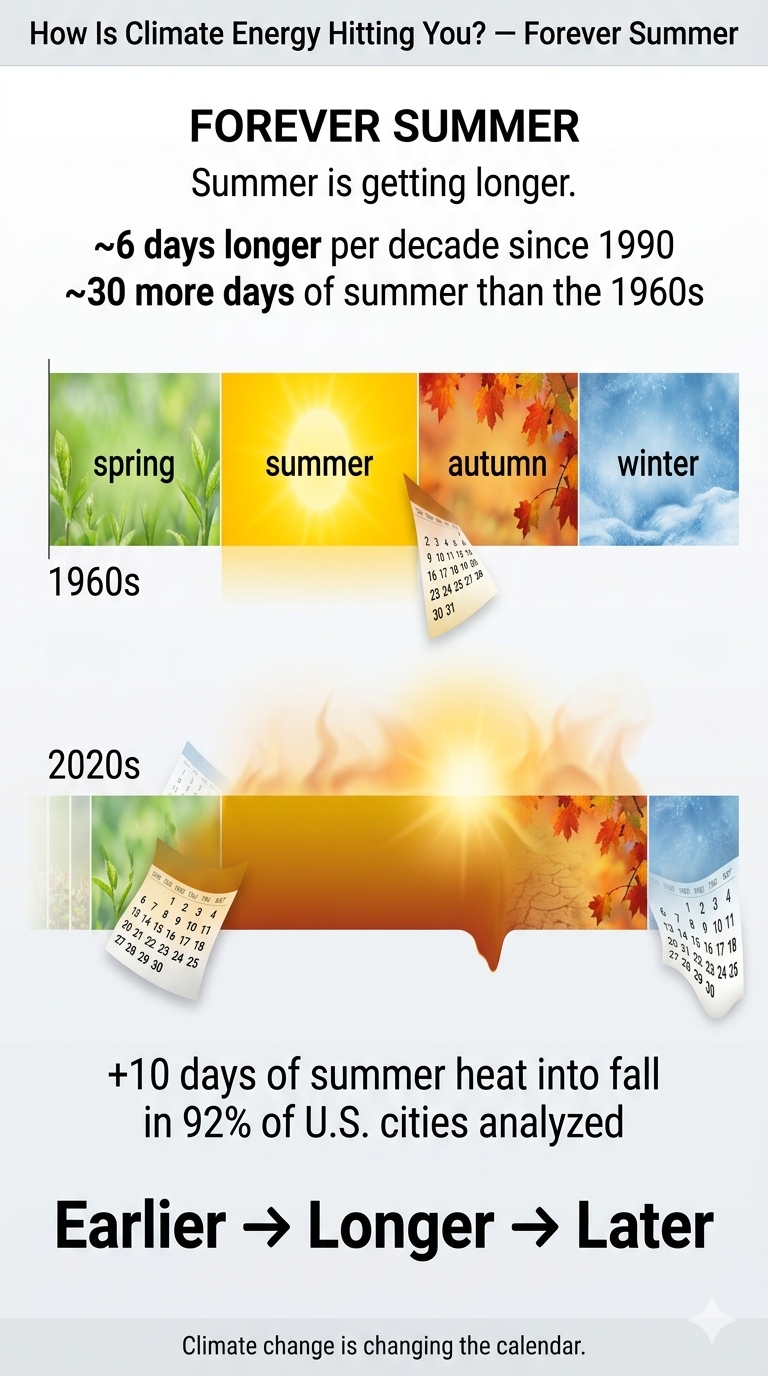
Human-caused climate change is expanding the global summer season by roughly six days longer per decade since 1990, causing summer weather to arrive earlier and linger much later into the year.
As global greenhouse gas emissions trap heat in the atmosphere, seasonal cycles are changing faster than previously measured. This shift alters traditional calendar boundaries and reshapes the planet’s climate patterns.
• Total seasonal gain – Research published by the University of British Columbia in Environmental Research Letters shows that summer-like weather in the midlatitudes lasts roughly 30 days longer today than it did in the 1960s.
• Lingering fall heat – Data from Climate Central indicates that summer temperatures now extend an average of 10 days later into autumn across a vast majority of analyzed U.S. cities.
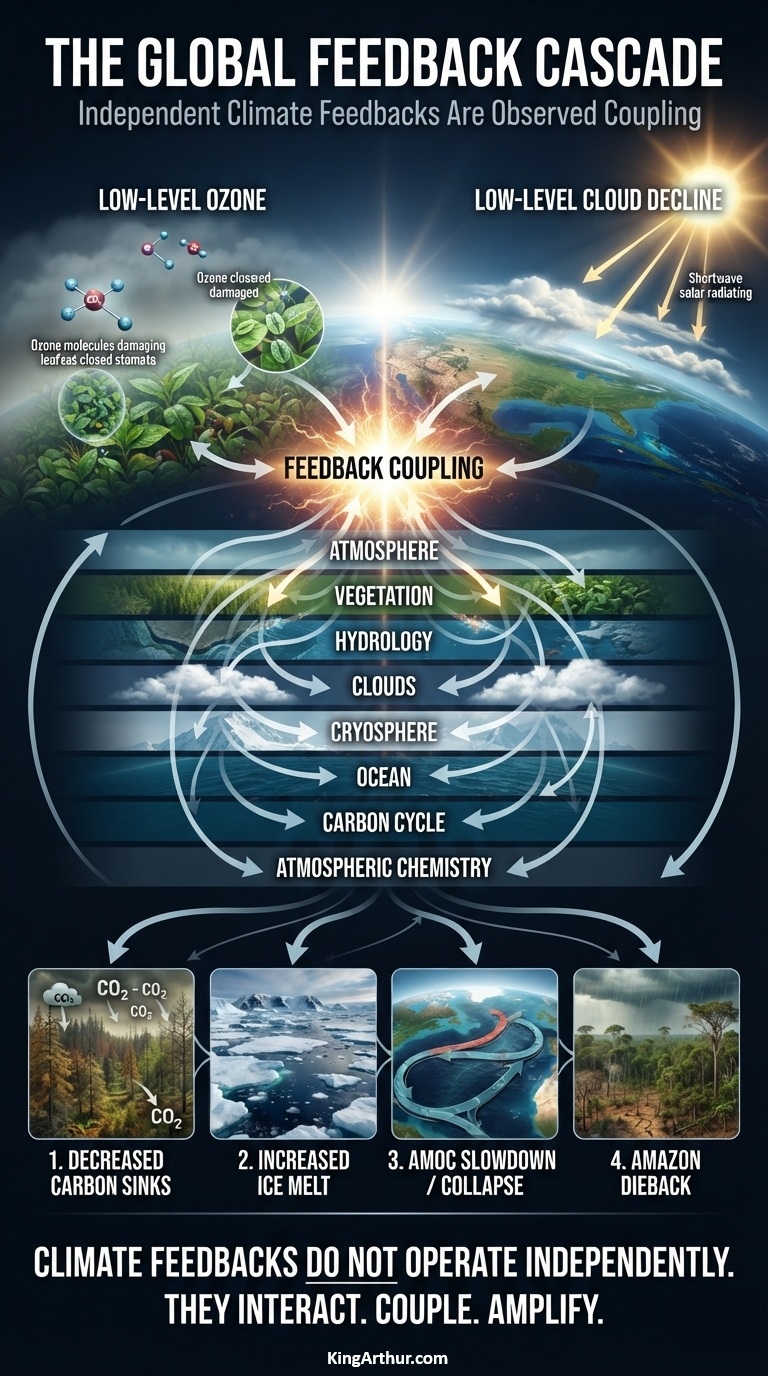
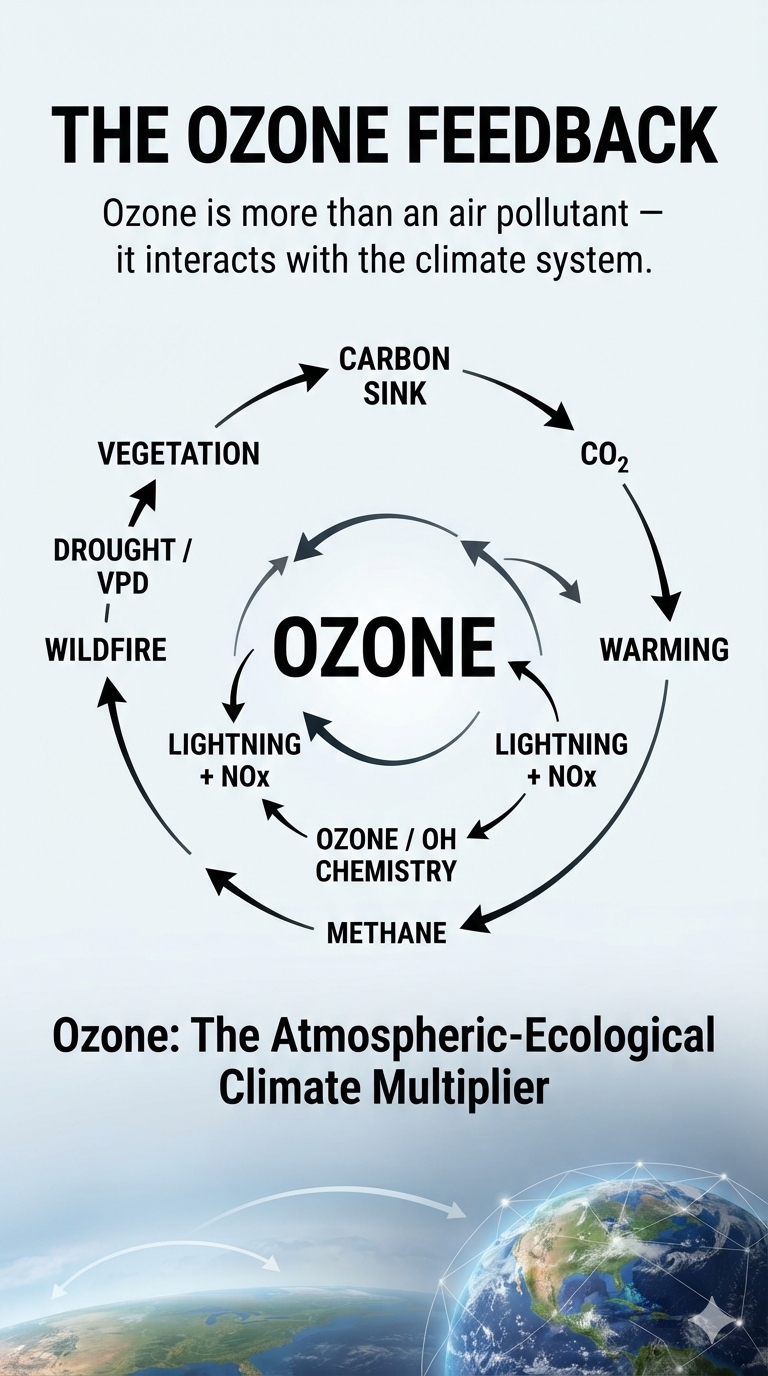
Increasing tropospheric ozone contributes to climate-system acceleration through simultaneous direct radiative forcing and indirect ecological forcing, with ozone-induced vegetation stress reducing carbon uptake, altering land-surface energy and water exchange, increasing ecosystem vulnerability, and interacting with wildfire, drought, methane, lightning, and other climate feedbacks. These coupled interactions may amplify climate-system responses beyond the effect of ozone considered as an isolated atmospheric constituent.
[Silence]
[Instrumental Intro: Piano, Deep Sub-Bass Synth, Acoustic Guitar, Organ, Harmonica, Tribal Percussion, Electric Slide Guitar]
[Intro]
Comin’ from the northeast
(A real beast)
Ridin’ the coast
(What a roast!)
Slowly movin’
(But not away)
Hangin’ around
(Another day)
[Verse 1]
Atlantic City
(Beach took a hit)
Half-mile stretch
(That’s some of it)
Dunes carved deeply
(Steep and tall)
Sand disappeared
(There goes the wall)
[Refrain]
Comin’ from the northeast
(A real beast)
… to say the least
Hangin’ out day after day
(No, just wont move away)
… ocean takes over the bay
[Verse 2]
Down in Brigantine
(The beach did flee)
Hundreds of feet
(Washed out to sea)
[Refrain]
Comin’ from the northeast
(A real beast)
… to say the least
Hangin’ out day after day
(No, just wont move away)
… ocean takes over the bay
[Verse 3]
Storm energy
(Turned into cost)
Flooded the streets
(What have we lost?)
[Bridge]
Storm energy!
(Flood and erosion!)
Wind energy!
(Coastal corrosion!)
Joules don’t stay
(In a textbook line)
They reach your house
(And they reach mine)
[Refrain]
Comin’ from the northeast
(A real beast)
… to say the least
Hangin’ out day after day
(No, just wont move away)
… ocean takes over the bay
[Breakdown]
Flooding!
(Erosion!)
Wind!
(Destruction!)
Power!
(Interruption!)
Traffic!
(Disruption!)
Property!
(Depreciation!)
Business!
(Complication!)
[Final Refrain]
Comin’ from the northeast
(A real beast)
… to say the least
Hangin’ out day after day
(No, just wont move away)
… ocean takes over the bay
[Outro]
Comin’ from the northeast
(What a beast!)
Turning energy
(Into receipts!)
Damage
(Becomes dollars)
Dam Age!
(Everybody hollers)
[Silence]
[End]
About the Song
The late-September 2026 nor’easter turned atmospheric and oceanic energy into a massive economic event.
$10–13 BILLION in estimated damage and economic losses.
Flooding.
Beach and dune erosion.
Downed trees.
Power outages.
Infrastructure damage.
Transportation disruption.
The storm demonstrates a simple connection:
STORM ENERGY → FLOODING + EROSION + WIND → DAMAGE → ECONOMIC LOSS
Climate energy does not remain an abstract number measured in joules. It reaches us through the places where we live, the infrastructure we depend upon, and the economic systems that connect us.
The Jersey Shore: Erosion, Flooding and Infrastructure Damage
The most concentrated physical damage occurred along exposed coastal communities.
Atlantic City
Atlantic City experienced some of its most severe beach erosion since Superstorm Sandy in 2012. A particularly hard-hit area extended for approximately a half-mile north of Steel Pier.
The storm carved deeply into the dunes, leaving steep sand escarpments and exposing previously buried structures. Atlantic City Beach Patrol officials reported that roughly half of the dunes remained in the affected area after the storm.
This is more than a cosmetic change to the beach. Dunes function as part of the coastal defense system. Removing large quantities of sand reduces the physical buffer between ocean waves and developed areas.
Brigantine
Brigantine also suffered extensive beach and dune erosion. City officials estimated that hundreds of feet of beach were washed away, while approximately 30 feet of dunes were lost in one particularly vulnerable area. Officials said the damage could amount to tens of millions of dollars.
The storm also damaged the city’s promenade. A newly installed beach-access ramp was torn from its foundation and carried approximately 30 blocks down the beach before being recovered. Sections of promenade railing were also damaged.
Mayor Vince Sera described the storm as producing exceptionally powerful ocean conditions, while city officials emphasized that the promenade and seawall helped protect homes and infrastructure from even greater damage.
Repeated Tidal Flooding
The storm’s slow movement and persistent onshore winds produced flooding over multiple high-tide cycles.
In Sea Bright, New Jersey, for example, successive tides repeatedly flooded neighborhoods rather than producing a single isolated flooding event. More than four inches of rain also fell in portions of New Jersey, adding freshwater runoff to the coastal flooding problem.
The combination of heavy rainfall + elevated ocean water + high tides + strong onshore winds created a compound flooding event.
[Instrumental Outro: guitar feedback, diesel-like bass rumble, drums gradually slowing into a single heartbeat]
[Fade out]
[End]
[Silence]
About the Song
Petro-Masculinity: The Cultural Engine
A related concept helps explain the cultural dimension of fossil-fuel politics: petro-masculinity.
Political scientist Cara Daggett introduced the term in her 2018 paper Petro-Masculinity: Fossil Fuels and Authoritarian Desire. Daggett argues that fossil-fuel systems can become connected not only to economic interests but also to identity, masculinity, authority, and resistance to social change.
The central idea is that fossil fuels can represent more than energy.
They can represent:
independence
personal freedom
economic security
traditional gender roles
national power
resistance to perceived cultural change
Fossil-fuel identity
During the twentieth century, American masculinity became closely associated with breadwinning, industrial employment, suburban development, automobile ownership, and inexpensive gasoline.
As a result, challenges to fossil-fuel consumption can sometimes be interpreted culturally rather than simply economically.
An electric vehicle, public transportation, reduced meat consumption, or restrictions on fossil-fuel use can be portrayed not merely as policy choices but as attacks on traditional identity.
This helps explain the cultural significance of behaviors such as “rolling coal,” in which modified diesel vehicles deliberately produce large quantities of exhaust smoke. The behavior can function as a form of political or cultural expression rather than transportation alone.
Petro-masculinity and authoritarianism
Daggett’s framework connects fossil-fuel dependence with authoritarian desire, particularly where climate action is interpreted as a threat to established gender roles, economic autonomy, or social status.
The connection to fossil fascism can therefore be understood at two levels:
Petro-masculinity is the cultural and identity dimension.
Fossil fascism is the political and institutional dimension.
The former can help create emotional resistance to changes in the energy system; the latter describes political structures and movements that defend fossil-fuel power.
About the Song
Fossil Fascism: Protecting Fossil Capital
Fossil fascism is related to, but distinct from, ecofascism.
The term has been used by scholars studying the intersection of fossil-fuel dependence, authoritarian politics, nationalism, racism, and opposition to climate action. Recent scholarship defines fossil fascism as a political, legal, and cultural system centered on an ultra-nationalist defense of fossil-fuel extraction while suppressing opposition to it.
In simplified terms:
Ecofascism accepts ecological crisis but blames the “outsider.”
Fossil fascism protects the fossil-fuel system and attacks those who seek to change it.
From “Blood and Soil” to “Black Fuel”
The historical roots of ecofascist thought are often connected to European romantic nationalism and the “Blood and Soil” tradition, in which land, national identity, and racial identity became intertwined.
Fossil fascism has a different historical lineage.
Political scientist Cara Daggett and other scholars have used the concept to examine the relationship between fossil fuels, authoritarian politics, nationalism, and racialized power. Andreas Malm and the Zetkin Collective further developed the concept in White Skin, Black Fuel, connecting fossil-fuel development to the history of European imperialism, colonialism, and racial hierarchy.
The underlying argument is that fossil fuels are not simply an energy source. They can also become embedded in political institutions, economic power, national identity, and cultural ideas about social hierarchy.
[Verse 1]
Ridin’ down the road
(He’s ridin’ his scapegoat)
Looking to blame
(Offload his shame)
Too many people
(Too many mouths)
Too many strangers
(From the south)
Point at the stranger
(Point and accuse)
Pick out an enemy
(Somebody to lose)
[Refrain]
Road in to town
(Ridin’ his scapegoat)
Deny what’s goin’ down
(Livin’ life cutthroat)
The Titanic Band
(Playin’ lifeboat ethics)
Man’s damned demand
(Is not joyful music)
Who gets to survive
(Arrive alive)
After what you’ve said
(We’ll all be dead)
[Verse 2]
“Overpopulation!”
(That’s the refrain)
“Too many people!”
(Again and again)
But who consumes
(And who consumes more?)
Who burns the fuel
(And who owns the store?)
[Refrain]
Road in to town
(Ridin’ his scapegoat)
Deny what’s goin’ down
(Livin’ life cutthroat)
The Titanic Band
(Playin’ lifeboat ethics)
Man’s damned demand
(Is not joyful music)
Who gets to survive
(Arrive alive)
After what you’ve said
(We’ll all be dead)
[Bridge]
This is the transformation
(Watch the meaning change)
Man’s devolution
From:
“What can we do?”
(To:)
“I’m blaming you”
[Break]
Scapegoat!
(Scape-goat!)
Ride it down
(Ride it out)
Shout it out!
(Scape-goat!)
What are you thinking…
(The ship is sinking)
[Final Refrain]
Road in to town
(Ridin’ his scapegoat)
Deny what’s goin’ down
(Livin’ life cutthroat)
The Titanic Band
(Playin’ lifeboat ethics)
Man’s damned demand
(Is not joyful music)
[Outro]
Who gets to survive
(Arrive alive)
After what you’ve said
(We’re all going to be dead)
Who gets to survive
(Who gets to thrive)
[Fade out]
Who gets to survive?
[Silence]
[End]
About the Song
Ecofascism: Climate Change as a Scapegoating Narrative
Ecofascism represents a fundamentally different approach.
Rather than denying climate change, ecofascist narratives accept environmental collapse but attribute it to supposedly undesirable populations—particularly immigrants, refugees, or people in the Global South.
The “overpopulation” narrative
One recurring theme is the claim that environmental degradation is primarily caused by population growth among poorer or non-white populations.
This can obscure the enormous differences in consumption and greenhouse-gas emissions between populations. High-income populations have historically produced far greater per-capita emissions than the world’s poorest populations.
The political transformation occurs when legitimate concerns about ecological limits are converted into arguments about which people supposedly deserve access to resources.
Blaming immigrants for environmental degradation
A related narrative links immigration directly to pollution, resource depletion, or greenhouse-gas emissions.
This is sometimes described as eco-bordering: using environmental concerns to justify more restrictive borders.
The danger of this framing is not the discussion of the environmental consequences of population growth or migration itself. Those are legitimate subjects for analysis. The problem arises when immigrants are treated as the primary ecological threat while the much larger effects of industrial energy systems, fossil-fuel consumption, land use, and unequal resource consumption are displaced from the discussion.
“Lifeboat ethics”
At its most extreme, ecofascist thinking adopts a form of “lifeboat ethics”: the assumption that resources are becoming so scarce that societies must protect their own populations by excluding outsiders.
Climate disasters can intensify this mentality. As droughts, floods, heat waves, sea-level rise, and food insecurity increase displacement, refugees can be portrayed not as people affected by climate change but as the cause of further environmental decline.
In its most extreme forms, this worldview has intersected with white-supremacist and accelerationist movements. Researchers have documented cases in which perpetrators of mass violence invoked “Great Replacement” ideas alongside environmental or resource-based fears.
The resulting political question changes from:
How do we respond to climate change?
to:
Who gets to survive climate change?
That is a profound shift in the political meaning of climate change.
[Silence]
[Instrumental Intro: electric piano, dark psychedelic acoustic guitar, pulsing bass, distant feedback]
[Verse 1]
First they say
(It isn’t real)
Nothing here
(That you can feel)
Just a cycle
(Just the weather)
Nothing’s changing
(Not together)
[Refrain]
Denial and delay
(Can’t last another day)
The cost too high to pay
(Denial and delay)
… just go away
[Verse 2]
Then the story
(Starts to change)
Now that warming
(Isn’t strange)
[Refrain]
Denial and delay
(Can’t last another day)
The cost too high to pay
(Denial and delay)
… just go away
[Instrumental, Acoustic Guitar and Electric Piano Jam]
[Bridge]
Is it denial?
(Is it delay?)
Is it doubt?
(Or a way?)
What uncertainty
(Do we stress?)
What consequences
(Do we suppress?)
[Refrain]
Denial and delay
(Can’t last another day)
The cost too high to pay
(Denial and delay)
… just go away
[Break]
Go away
(You can’t sway)
Denial
(Go away)
… you can’t stay
[Outro]
Denial and delay
(Can’t last another day)
The cost too high to pay
(Denial and delay)
You can look away
(But it won’t go away)
You can say
(Just go away)
But the world won’t
(Go away)
[Outro]
Denial and delay
(Can’t last another day)
The cost too high to pay
(Denial and delay)
… just go away
[Instrumental Outro: distorted guitar, pulsing bass, feedback fading into silence]
[Fade out]
[Silence]
[End]
About the Song
Climate Denial and Climate Delay
The most familiar form of climate misinformation is outright denial: rejecting the existence, severity, or human cause of climate change.
Political rhetoric has also attacked renewable energy through claims that wind turbines, solar power, or other clean-energy technologies are inherently dangerous or economically destructive. Some of these claims have been challenged by scientific evidence, while others involve legitimate questions about environmental impacts that require quantitative comparison rather than political rhetoric.
As public acceptance of climate change has increased, however, the political emphasis has increasingly shifted from denying the problem to opposing proposed solutions. Researchers commonly describe this strategy as climate delay.
The basic argument changes from:
“Climate change isn’t happening.”
to:
“Climate change may be happening, but addressing it will cause even greater economic or social damage.”
This framing can emphasize immediate costs—higher energy prices, job losses, grid reliability, restrictions on vehicles or industrial activity—while giving less attention to the long-term economic costs of continued warming.
Government-sponsored challenges to climate science
A prominent recent example was the U.S. Department of Energy’s July 2025 publication of A Critical Review of Impacts of Greenhouse Gas Emissions on the U.S. Climate. The report was produced by five scientists assembled by Energy Secretary Chris Wright and argued, among other things, that the economic damages from CO₂-induced warming may be smaller than commonly believed and that aggressive mitigation policies could be more harmful than beneficial.
Carbon Brief subsequently conducted a detailed fact-check with climate scientists and reported more than 100 statements it characterized as false or misleading, including claims involving the economic consequences of climate change, extreme weather, and the interpretation of scientific literature.
The significance of such disputes is not simply whether individual claims are correct. It is also about which scientific evidence is selected, which uncertainties are emphasized, and how those choices are translated into public policy.