Declining Low-Level Clouds: The Emerging Climate Mega-Multiplier
The most significant emerging climate feedback accelerating the planetary energy imbalance is the decline in low-level clouds.
Low-level clouds occupy a unique position in the climate system, directly regulating incoming solar energy while interacting with atmospheric moisture, ocean temperatures, aerosols, atmospheric chemistry, vegetation, and planetary albedo. Their decline therefore does more than add another feedback—it increases the energy available to amplify other feedbacks, making low-level cloud loss a climate mega-multiplier operating directly through Earth's energy budget.
Simplified Introduction
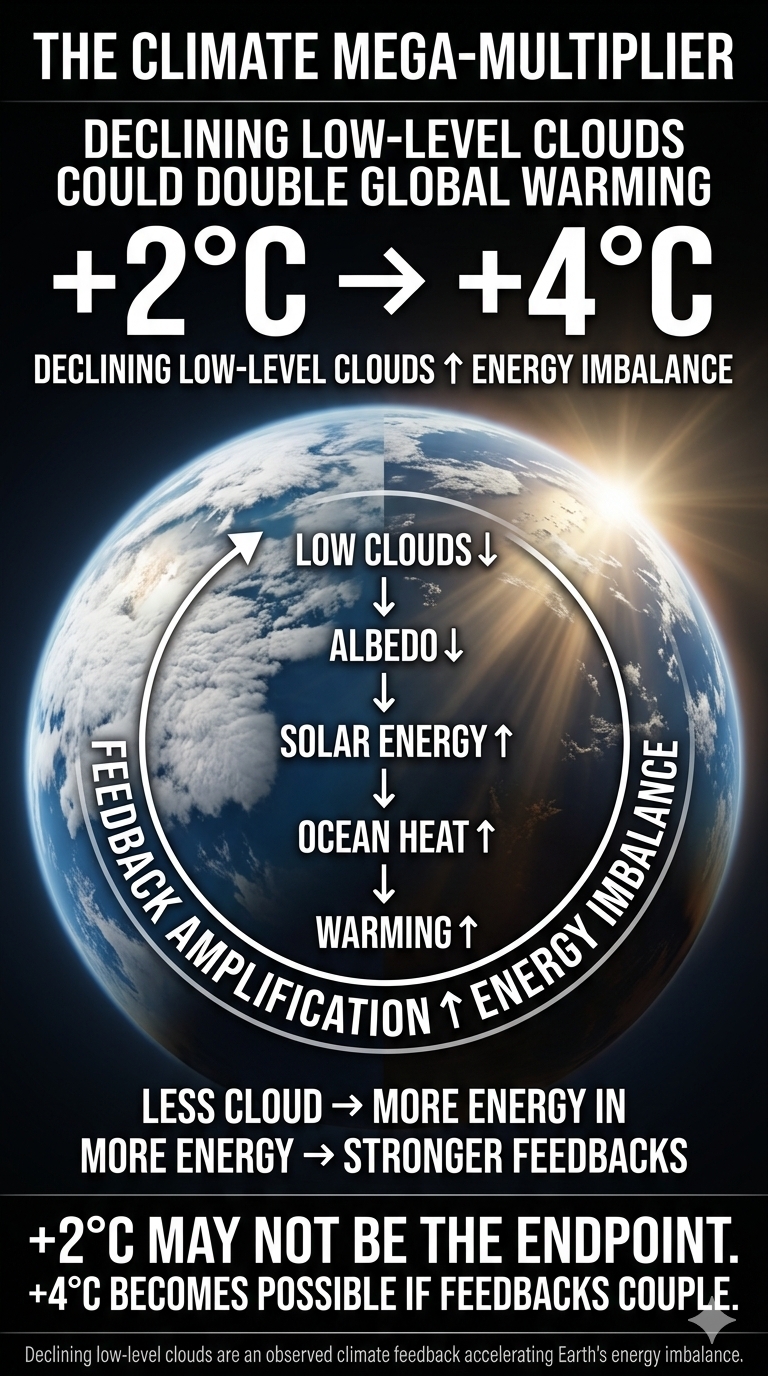
DECLINING LOW-LEVEL CLOUDS COULD DOUBLE GLOBAL WARMING
We tend to think of climate change as a greenhouse-gas problem. But the bigger story is what happens after the warming starts.
One of the most important emerging changes is happening above the oceans: low-level clouds are declining.
That matters because low-level clouds act like a planetary shade.
Less low-level cloud cover means:
Less sunlight reflected back to space
→ more solar energy absorbed by Earth
→ greater planetary energy imbalance
→ more ocean and surface heating
→ more warming.
And that extra energy doesn’t stay in the clouds. It feeds the rest of the climate system. More warming means more ice loss. Less ice means less reflection. More atmospheric moisture strengthens the greenhouse effect.
Tropospheric ozone damages vegetation, reducing photosynthesis and transpiration. Less transpiration changes atmospheric moisture and cloud-forming conditions. And declining clouds allow even more solar energy into the system.
The feedbacks begin connecting:
CLOUDS → ALBEDO → OCEAN HEAT → ICE → ALBEDO
and
OZONE → VEGETATION → TRANSPIRATION → CLOUDS
and
WARMING → WATER VAPOR → GREENHOUSE EFFECT → WARMING
These are not hypothetical climate mechanisms. The individual processes are observed.
The emerging issue is that they are increasingly interacting.
That changes the question we should be asking.
Not simply:
“How much warming does each feedback cause?”
But:
“Are the feedbacks beginning to amplify one another?”
That is the Climate Feedback Cascade. And low-level clouds are at the center of it.
The most significant emerging climate feedback accelerating the planetary energy imbalance is the decline in low-level clouds.
Read the full public-access paper:
Declining Low-Level Clouds: The Mega-Multiplier
The Earth’s climate system is undergoing a measurable acceleration in the redistribution and accumulation of energy. One of the most important emerging contributors is the decline in low-level clouds, which reduces the amount of incoming solar radiation reflected back to space and increases the amount of energy absorbed by the Earth system.
This paper synthesizes observations and research concerning declining low-level clouds, planetary albedo, ocean heat content, atmospheric water vapor, tropospheric ozone, vegetation stress, sea-ice loss, and ocean circulation. The evidence demonstrates that these processes are not isolated. They are interacting components of a coupled Earth system.
Low-level cloud decline is especially significant because it directly changes the planetary energy budget:
Low-level clouds ↓ → planetary albedo ↓ → solar absorption ↑ → energy imbalance ↑ → ocean and surface warming ↑.
That additional energy then interacts with other observed climate changes. Ocean warming contributes to cryospheric loss. Cryospheric loss reduces surface reflectivity. Tropospheric ozone damages vegetation and reduces stomatal conductance and transpiration. Reduced transpiration alters atmospheric moisture and cloud-forming conditions. Cloud decline increases solar absorption, reinforcing warming and further activating climate feedbacks.
The resulting system is not adequately described as a collection of independent feedbacks. The observations show increasing coupling among atmospheric, oceanic, cryospheric, biological, and chemical processes.
The central conclusion is therefore direct:
The decline in low-level clouds is an observed climate feedback that is accelerating the planetary energy imbalance and coupling with other climate feedbacks.
This coupling represents a major transition in climate behavior. The critical issue is no longer simply whether individual feedbacks exist. They do. The critical issue is how rapidly those feedbacks are coupling and amplifying one another.
1. Introduction
Climate change is commonly described as a consequence of increasing greenhouse-gas concentrations.
That description is incomplete. Greenhouse gases initiate and amplify a change in Earth’s energy balance, but the subsequent trajectory is determined by the response of the entire Earth system. The atmosphere, oceans, cryosphere, biosphere, and land surface continuously interact.
A warming atmosphere changes clouds. Changing clouds alter planetary albedo. Changing albedo alters solar absorption. Additional absorbed energy heats the oceans and surface. Ocean warming changes evaporation, circulation, sea ice, and atmospheric conditions. Vegetation responds to temperature, water availability, atmospheric chemistry, and radiation. Tropospheric ozone damages vegetation. Vegetation changes atmospheric moisture and carbon uptake.
The resulting changes feed back into the atmosphere.
This is not theoretical architecture. These processes are being observed.
The fundamental scientific problem is therefore increasingly one of feedback coupling.
Among these feedbacks, declining low-level clouds occupy a particularly important position because clouds directly regulate the amount of solar energy entering the Earth system.
2. Low-Level Clouds Are a Planetary Sunshade
Low-level clouds reflect incoming shortwave radiation. Their cooling influence is therefore fundamentally different from the greenhouse effect of high clouds and atmospheric greenhouse gases. When reflective low-level clouds decline, the planet reflects less sunlight. The result is an increase in absorbed solar radiation.
The sequence is:
Low-level cloud decline
↓
Reflectivity decline
↓
Solar radiation reflected to space decreases
↓
Solar radiation absorbed by Earth increases
↓
Planetary energy imbalance increases
This is a direct physical relationship. No additional greenhouse-gas emissions are required for the feedback to operate.
The loss of reflective cloud cover itself changes the energy balance.
3. The Observed Energy Imbalance
Earth is accumulating energy because more energy is entering the climate system than is leaving it. The overwhelming majority of that excess energy is entering the ocean. Ocean heat content therefore provides one of the clearest measures of the changing energy state of the planet.
The significance of declining low-level clouds is that they provide a direct mechanism for increasing the amount of solar energy retained by the system.
The cloud signal must therefore be considered together with ocean heat content.
The relationship is:
Cloud reflection ↓ → absorbed solar radiation ↑ → ocean heat accumulation ↑.
Recent observations show an extraordinary increase in Earth’s energy imbalance.
This makes changes in planetary reflectivity increasingly consequential.
A relatively small change in reflected solar energy becomes significant when it operates continuously across enormous areas of the global ocean.
4. The Low-Level Cloud Feedback Is Already Operating
The central question is not whether declining low-level clouds could become a feedback. They are a feedback.
The physical mechanism is established:
Cloud decline → reduced reflection → increased solar absorption.
The observed decline therefore constitutes an additional warming influence within an already warming climate. The significance comes from the fact that the feedback reinforces the original perturbation. Warming changes the atmospheric and oceanic conditions that regulate clouds. Cloud changes then alter the energy entering the system. That additional energy produces further warming.
The cycle is:
Warming → cloud change → reduced reflection → increased energy absorption → additional warming.
This is positive feedback.
5. The Mega-Multiplier
The term “mega-multiplier” describes the role of low-level cloud decline within the larger climate-feedback network. It does not mean that clouds independently produce an arbitrary amount of warming. It means that the loss of low-level cloud reflection increases the energy available to drive other feedbacks. The distinction is critical.
An additional unit of absorbed solar energy does not remain confined to the cloud system. It enters the Earth system. The ocean absorbs it. The atmosphere responds. Ice melts. Water vapor changes. Vegetation responds. Atmospheric chemistry changes. Ocean circulation responds.
The original cloud change therefore propagates through the Earth system.
This makes low-level cloud decline a feedback amplifier.
6. The Albedo–Cloud–Ocean Heat Connection
Three variables are particularly important:
- planetary albedo
- low-level cloud cover
- ocean heat content.
Their relationship forms a coherent physical chain.
Low-level clouds ↓
↓
Planetary albedo ↓
↓
Absorbed solar energy ↑
↓
Ocean heat content ↑
The observed relationship between these variables is a central component of the Climate Jerk Surge analysis. The significance is not simply that each variable is changing. The significance is that they are changing in a direction that reinforces the same underlying energy imbalance.
This is evidence of an increasingly coupled climate system.
7. Climate Feedbacks Are Coupling
Climate feedbacks are commonly discussed independently. Water vapor feedback is considered separately from cloud feedback. Cloud feedback is considered separately from ice-albedo feedback. Vegetation feedback is considered separately from atmospheric chemistry. Ocean circulation is considered separately from atmospheric processes. That separation is useful for studying individual mechanisms. It becomes inadequate when the mechanisms interact.
The observed system is:
Atmosphere ↔ clouds ↔ radiation ↔ ocean ↔ cryosphere ↔ biosphere ↔ atmospheric chemistry.
The important development is therefore not simply the strengthening of individual feedbacks.
It is the increasing coupling between them.
8. Tropospheric Ozone and Vegetation
Tropospheric ozone provides a second major pathway into the feedback network. Unlike stratospheric ozone, which protects Earth from ultraviolet radiation, tropospheric ozone is an air pollutant and greenhouse gas. It enters plant leaves through stomata and damages photosynthetic tissue. The consequences are measurable. Ozone exposure reduces photosynthetic productivity and causes plants to restrict stomatal opening.
That produces two important feedback pathways.
Carbon uptake
Tropospheric ozone ↑
↓
Vegetation damage ↑
↓
Photosynthesis ↓
↓
Carbon uptake ↓
↓
Atmospheric CO₂ ↑
↓
Warming ↑
Transpiration
Tropospheric ozone ↑
↓
Stomatal conductance ↓
↓
Transpiration ↓
↓
Atmospheric moisture redistribution changes
↓
Cloud-forming conditions change
The ozone feedback therefore connects atmospheric chemistry to both the carbon cycle and hydrological cycle.
9. Ozone–Cloud Coupling
The evidence increasingly indicates that ozone and clouds should not be treated as independent climate variables. Vegetation continuously exchanges water with the atmosphere. When ozone damages vegetation and reduces stomatal conductance, transpiration decreases. That changes the amount of water entering the lower atmosphere. Cloud formation depends on atmospheric moisture, stability, temperature, aerosols, and circulation. Therefore, vegetation damage changes one of the fundamental inputs to the cloud system.
The resulting chain is:
Ozone ↑ → vegetation damage ↑ → transpiration ↓ → atmospheric moisture changes → low-level cloud changes.
At the same time:
Low-level clouds ↓ → solar radiation reaching the surface ↑ → vegetation heat and water stress ↑.
These are opposing directions of causality operating within the same system.
The result is a coupled ozone–vegetation–cloud feedback.
10. Clouds and the Cryosphere
The cloud feedback also connects directly to the cryosphere. Less reflective cloud cover means more solar radiation reaches the surface. Additional absorbed energy contributes to warming. Warming reduces snow and ice. Snow and ice are highly reflective. Their loss therefore produces another reduction in planetary albedo.
The sequence becomes:
Low clouds ↓
↓
Solar absorption ↑
↓
Warming ↑
↓
Snow and ice ↓
↓
Surface albedo ↓
↓
Solar absorption ↑
This is a reinforcing feedback loop.
The original cloud decline therefore amplifies another established climate feedback.
11. Cloud Decline and Ocean Heating
The ocean is the principal reservoir receiving the excess energy accumulated by the Earth system. This makes the ocean the central link between atmospheric radiative changes and long-term climate response. Low-cloud decline increases solar energy reaching the ocean. The additional energy is absorbed by the upper ocean and redistributed through mixing and circulation.
This affects:
- sea-surface temperature
- evaporation
- atmospheric moisture
- ocean stratification
- marine ecosystems
- sea-ice formation
- atmospheric circulation.
The cloud feedback therefore becomes an ocean feedback.
This is one reason the magnitude of cloud changes cannot be evaluated solely through surface temperature.
The appropriate measurement is the energy entering the complete climate system.
12. Water Vapor and Cloud Coupling
Water vapor is Earth’s most important natural greenhouse gas. Warming increases atmospheric water-holding capacity. More atmospheric moisture increases greenhouse trapping.
The sequence is:
Warming ↑ → atmospheric water vapor ↑ → infrared heat retention ↑ → warming ↑.
Clouds interact directly with this process. The atmosphere cannot be divided into independent “water vapor” and “cloud” compartments. Water vapor condenses into clouds. Clouds redistribute water. Clouds alter radiation. Radiation alters evaporation. Evaporation alters atmospheric moisture. The resulting system is a coupled hydrological-radiative feedback.
The combination of increasing atmospheric moisture and declining low-level cloud reflection therefore produces reinforcing radiative effects.
13. Amazon Feedback
The Amazon illustrates how the same feedback network extends into the biosphere. The forest is both a major carbon reservoir and a major component of regional atmospheric moisture recycling. Vegetation transfers enormous quantities of water from soil to atmosphere through transpiration. Ozone damage reduces this process. Heat and drought increase vegetation stress. Cloud changes alter the amount of solar radiation reaching the forest.
The combined sequence is:
Ozone damage → transpiration decline → atmospheric moisture disruption
and:
Low-cloud decline → solar heating increase → vegetation stress increase.
Reduced vegetation productivity then weakens carbon uptake.
The forest consequently becomes both a victim and a contributor to the changing climate system.
14. AMOC and Ocean Circulation
The same feedback network extends into the Atlantic Ocean. The Atlantic Meridional Overturning Circulation depends on the density of North Atlantic waters. Temperature and salinity determine that density. Warming makes seawater less dense. Freshwater input from melting ice reduces salinity and also makes seawater less dense. Both processes inhibit deep-water formation.
The feedback chain is therefore:
Warming ↑ → ice loss ↑ → freshwater input ↑ → North Atlantic salinity ↓ → density ↓ → deep-water formation ↓ → AMOC weakening.
Additional ocean warming resulting from increased solar absorption adds pressure to this system.
AMOC weakening then changes heat transport and atmospheric circulation.
It is therefore another example of feedback operating across system boundaries.
15. Feedbacks Within Feedbacks
The most important feature of the emerging climate system is that feedbacks do not operate independently.
Consider the following sequence:
Low clouds ↓
→ albedo ↓
→ solar absorption ↑
→ ocean warming ↑
→ sea ice ↓
→ albedo ↓
→ solar absorption ↑
At the same time:
Ozone ↑
→ vegetation damage ↑
→ transpiration ↓
→ atmospheric moisture changes
→ low clouds ↓
→ solar absorption ↑
And:
Warming ↑
→ atmospheric water vapor ↑
→ greenhouse trapping ↑
→ warming ↑
These loops intersect.
That intersection is the key.
The climate system is developing feedbacks within feedbacks.
16. From Linear Warming to Nonlinear Acceleration
A climate system dominated by relatively independent feedbacks can be approximated as a collection of additive responses. A strongly coupled system behaves differently. When one feedback strengthens another, the response becomes nonlinear.
The sequence becomes:
Forcing → warming → feedback activation → feedback coupling → amplification → additional warming → additional feedback activation.
The important change is therefore not merely the temperature. It is the rate of change.
Temperature:
T
Rate of warming:
dT/dt
Acceleration:
d²T/dt²
Change in acceleration:
d³T/dt³
The third derivative provides a mathematical representation of whether climate acceleration itself is accelerating.
This is the basis of the Climate Jerk framework.
17. Climate Jerk Surge
The Climate Jerk Surge analysis examines multiple climate variables simultaneously, including:
- atmospheric water vapor
- planetary albedo
- low-level cloud cover
- sea ice
- ocean heat content
- surface temperature.
The variables are normalized and examined for changes in their rates of change and interactions. The purpose is not to replace established climate indicators. It is to identify whether the climate system is becoming increasingly dynamic. The most important observation is the emergence of strong relationships among cloud cover, albedo, and ocean heat content.
These relationships indicate that the energy imbalance is not simply continuing.
The system is becoming increasingly coupled.
18. The Feedback Cascade
The combined evidence produces a recognizable sequence:
Stage 1 — Initial warming
Greenhouse forcing increases atmospheric and oceanic temperatures.
Stage 2 — Feedback activation
Water vapor, ice loss, cloud changes, vegetation stress, and atmospheric chemistry respond.
Stage 3 — Feedback coupling
Individual responses begin influencing one another.
Stage 4 — Energy amplification
Additional solar absorption, greenhouse trapping, and reduced carbon uptake increase retained energy.
Stage 5 — Nonlinear acceleration
The rate of change of the climate system increases.
Stage 6 — Threshold behavior
Individual components approach thresholds at which their behavior changes rapidly.
Stage 7 — Cascade
Changes in one subsystem propagate into others.
This is the mechanism behind a climate-feedback cascade.
19. Why Low-Level Clouds Are the Mega-Multiplier
Low-level clouds occupy a unique position within this network because they directly regulate the amount of incoming solar energy reaching Earth. Covering enormous areas, they interact with atmospheric moisture, ocean temperatures, aerosols, and atmospheric chemistry while influencing both surface temperatures and ocean heating. Through the hydrological cycle, they also interact with vegetation and contribute directly to planetary albedo.
Consequently, a decline in low-level clouds does not simply add another feedback to the climate system.
It increases the energy available to drive other feedbacks.
That is why the term mega-multiplier is appropriate.
The multiplier operates through the energy budget.
20. The Central Finding
The central finding of this synthesis is:
The decline in low-level clouds is an observed positive climate feedback that increases absorbed solar energy and is becoming increasingly important as the Earth’s energy imbalance grows.
The evidence also shows that this feedback does not operate independently.
It intersects with:
- ocean heat accumulation
- planetary albedo
- sea-ice loss
- atmospheric water vapor
- tropospheric ozone
- vegetation productivity
- evapotranspiration
- carbon uptake
- hydrological change
- ocean circulation.
The significance is therefore systemic.
The climate system is not merely warming.
Its internal feedback network is changing.
21. The Scientific Challenge
The scientific challenge is no longer simply to establish whether these individual processes exist. They do.
The challenge is to quantify the rate at which they are coupling.
The critical questions are:
How rapidly is low-level cloud reflectivity declining?
How much additional solar energy is entering the system as a result?
How much of that energy is entering the ocean?
How strongly is the additional energy accelerating cryospheric loss?
How strongly is ozone-driven vegetation damage altering atmospheric moisture?
How strongly are vegetation, cloud, and atmospheric-chemistry changes reinforcing one another?
How strongly is additional warming affecting ocean circulation?
Are these feedback connections strengthening with time?
These questions can be answered through observations.
They require coordinated analysis of atmospheric, oceanic, cryospheric, biological, and chemical datasets.
22. Conclusion
The evidence demonstrates that Earth’s climate is a coupled energy system undergoing rapid change. Low-level clouds are a critical component of that system because they reflect incoming solar radiation. When low-level clouds decline, planetary reflectivity declines. When planetary reflectivity declines, more solar energy is absorbed. That energy enters the atmosphere, land, and especially the ocean.
The resulting warming activates and strengthens other feedbacks.
Sea ice declines.
Surface albedo declines.
Atmospheric water vapor increases.
Vegetation experiences increasing stress.
Tropospheric ozone damages vegetation and reduces stomatal conductance.
Reduced transpiration changes atmospheric moisture.
Cloud-forming conditions change.
Ocean circulation responds to warming and freshwater input.
The individual feedbacks are therefore connected. The resulting system is not a simple linear chain. It is a network of interacting feedback loops.
The most important development is the emergence of feedback coupling.
Low-level cloud decline sits near the center of that coupling because it directly controls the amount of solar energy entering the system.
The conclusion is therefore straightforward:
The most significant emerging climate feedback accelerating the planetary energy imbalance is the decline in low-level clouds.
The loss of low-level cloud reflection is not merely another symptom of climate change. It is an active mechanism increasing the energy entering the Earth system. And because that additional energy is being injected into a climate system already experiencing accelerating changes in the cryosphere, biosphere, atmosphere, and oceans, the effect extends far beyond clouds.
The climate system is not simply getting warmer. Its feedbacks are becoming coupled.
That is the emerging climate risk.
Sources
Low-Level Cloud Feedback: The Mega-Multiplier — An Additional 1.5°C to 2°C • Albedo–Cloud–Ocean Heat Content Feedback Triad (Climate Jerk Surge Math & Methods) • Feedback Loop and Tipping-Point Network • The Global Feedback Cascade: Ozone and Cloud Feedback Coupling • Low-Level Ozone – Clouds = Slowing AMOC and Collapse • Water Vapor + Clouds: Coupled Feedbacks Driving a Warmer Planet
Feedback Loops → Tipping Points → Feedback Loop and Tipping-Point Network → Acceleration → Domino Effect
Feedback loops amplify climate change and can push interconnected Earth systems past critical tipping points. As tipping points are crossed, they can trigger additional feedback loops and destabilize other climate systems. This cascading "Domino Effect" compresses timescales, accelerates change, and increases the risk of rapid, nonlinear climate transformations.
Easy-to-Read Resources