Songs about the climate science of climate change.
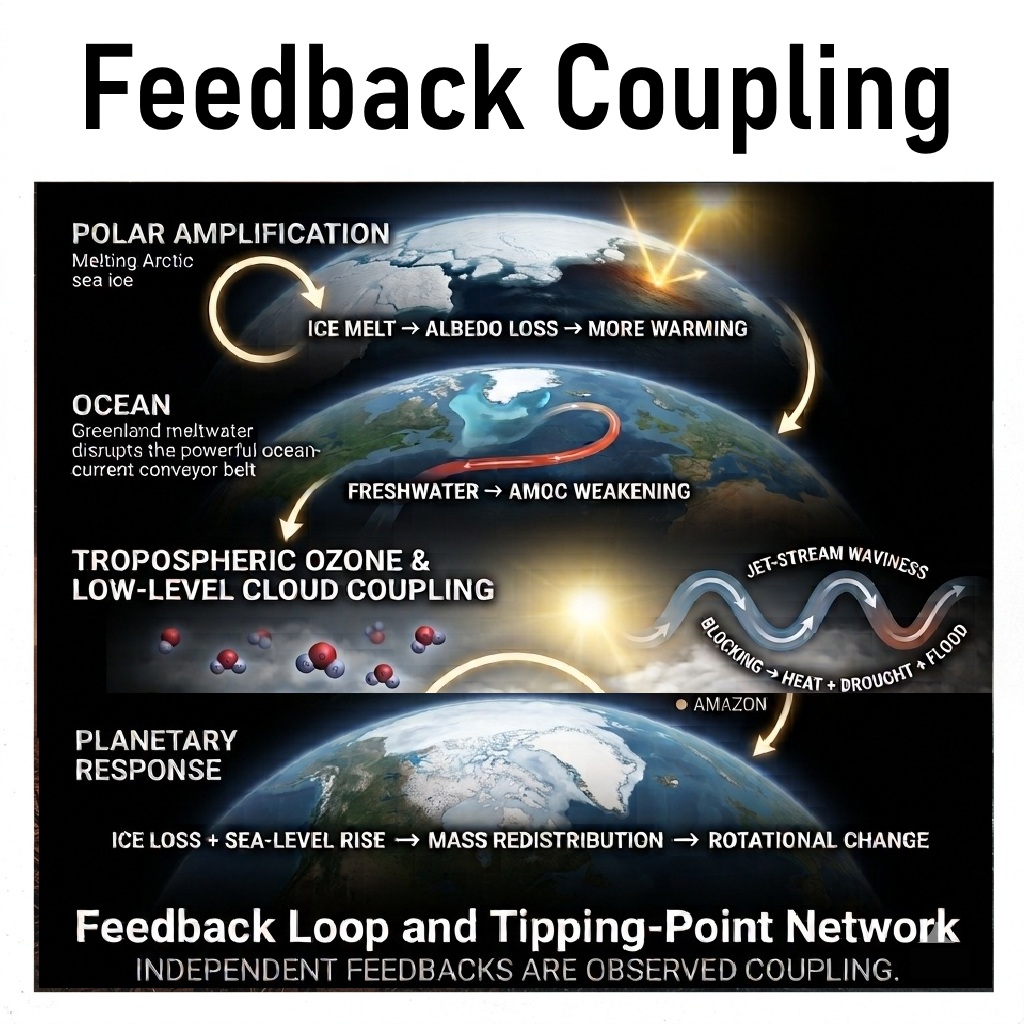
Feedback Loops → Tipping Points → Feedback Loop and Tipping-Point Network → Acceleration → Domino Effect
Feedback loops amplify climate change and can push interconnected Earth systems past critical tipping points. As tipping points are crossed, they can trigger additional feedback loops and destabilize other climate systems. This cascading "Domino Effect" compresses timescales, accelerates change, and increases the risk of rapid, nonlinear climate transformations.
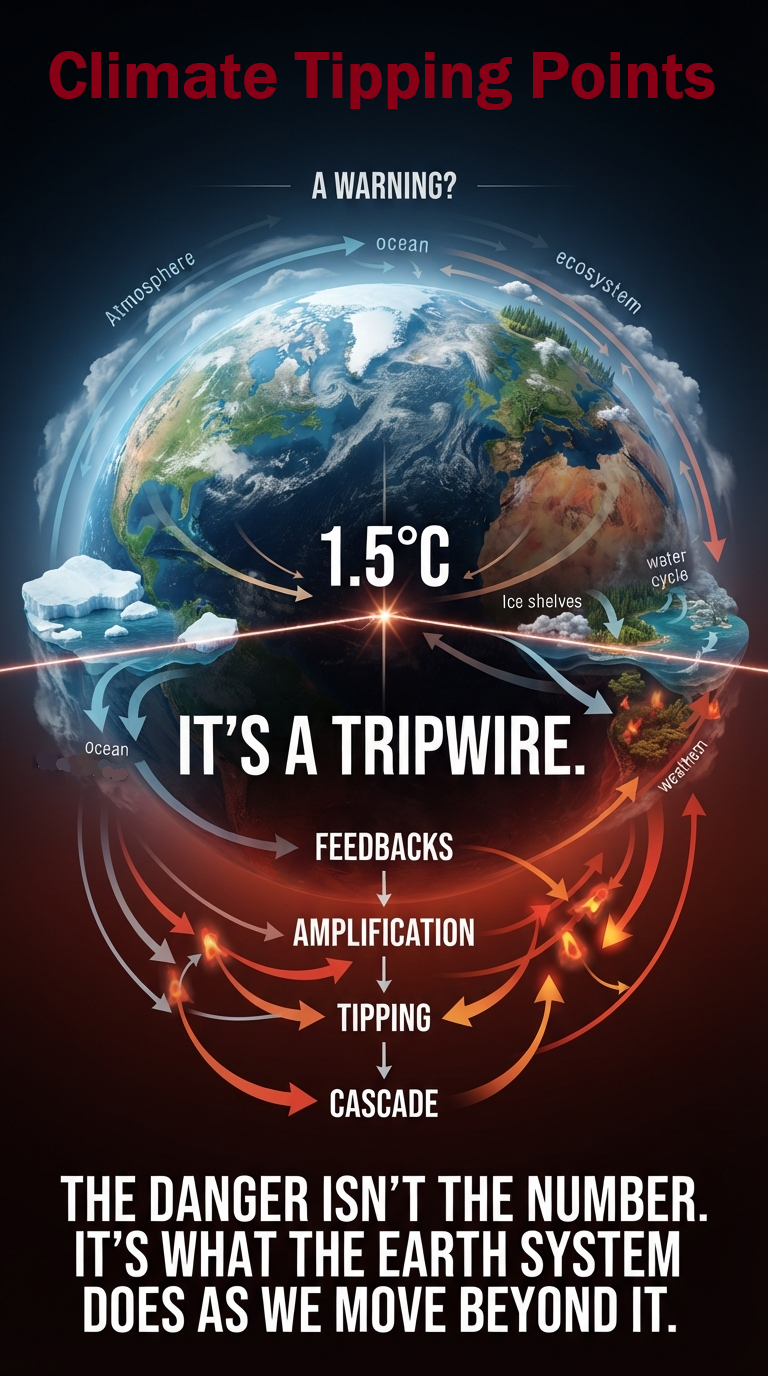
The 1.5°C threshold identified in the Paris Agreement—and the roughly 2°C level generally regarded as an even more dangerous boundary—is not important because the difference between 1.4°C and 1.5°C is somehow magical. These numbers matter because increasing global temperatures raise the probability of triggering major climate tipping points.
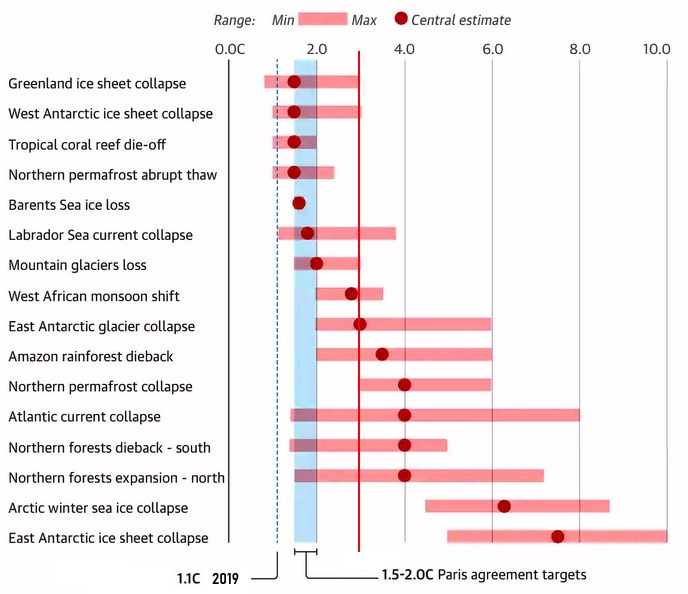
And once tipping points begin to activate, the question of whether warming ultimately reaches 2°C, 3°C, or even 4–7°C becomes much less relevant for two fundamental reasons:
First, tipping points can initiate self-reinforcing feedbacks that continue driving change even after the original forcing changes.
Second, the impacts do not necessarily increase gradually with temperature. They can accelerate, compound, and cascade as interconnected systems begin to destabilize.
In other words, 1.5°C is not a destination. It is not merely a warning sign or an alarm. It is a tripwire.
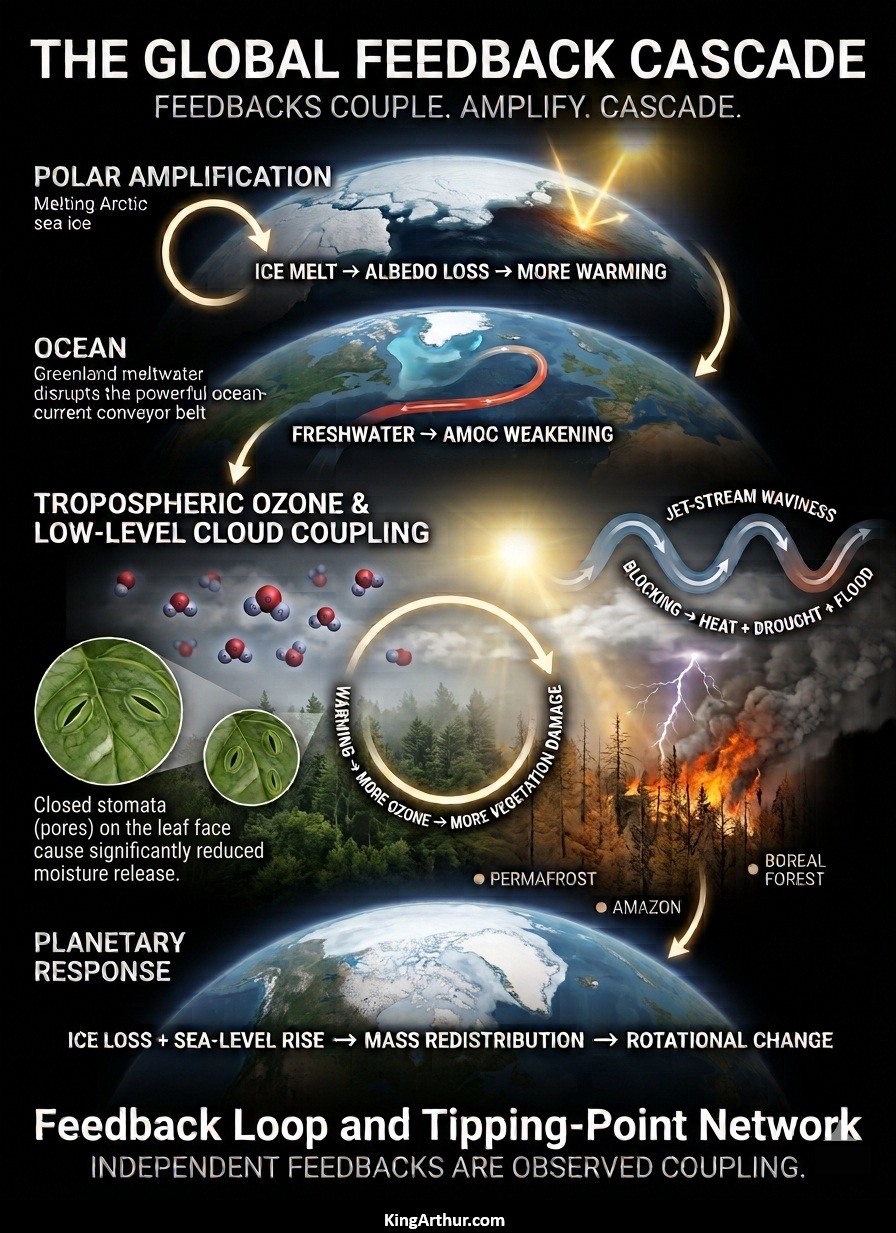
Polar amplification → weakened equator-to-pole temperature gradients → reduced thermal contrast → atmospheric circulation changes → accelerated Arctic and Greenland ice melt → ICE–ALBEDO FEEDBACK: ice loss → darker surface → greater solar absorption → more warming → more ice loss ↺ → MELT–ELEVATION FEEDBACK: ice loss → lower ice-sheet elevation → warmer air → faster surface melt → further elevation loss ↺ → LAPSE-RATE FEEDBACK: Arctic warming → weaker vertical temperature gradient → reduced atmospheric cooling efficiency → additional near-surface warming → more ice melt ↺ → COUPLED CRYOSPHERIC AMPLIFICATION → freshwater input into the North Atlantic → reduced salinity + density → AMOC weakening →
AMOC–CLOUD FEEDBACK: AMOC weakening → North Atlantic temperature + circulation changes → altered moisture transport → declining low-level clouds → reduced reflection of incoming solar radiation → increased solar absorption → additional ocean warming → further AMOC stress ↺ →
AMOC–OZONE FEEDBACK: AMOC weakening + altered circulation → changes in atmospheric chemistry + precursor transport → tropospheric ozone → vegetation damage → reduced stomatal conductance + photosynthesis → reduced evapotranspiration → lower atmospheric moisture → declining low-level clouds → increased solar absorption → additional warming → further AMOC stress ↺ →
AMOC–ICE-MELT FEEDBACK: AMOC weakening → altered North Atlantic heat transport → regional ocean-atmosphere temperature redistribution → Greenland + Arctic ice melt → freshwater discharge → reduced salinity + density → weaker deep-water formation → further AMOC weakening ↺ →
GLACIAL-RETREAT FEEDBACK: warming → glacier + ice-sheet retreat → reduced reflectivity + lower ice-sheet elevation → greater solar absorption + enhanced surface melt → additional warming + ice loss ↺ → SEA-LEVEL RISE → coastal inundation + saltwater intrusion + altered ocean circulation → additional cryospheric + ecosystem stress →
WILDFIRE–OZONE FEEDBACK: warming + drought → increased wildfire risk → vegetation loss + smoke + atmospheric emissions → increased ozone precursors → tropospheric ozone formation → vegetation damage → reduced carbon uptake + evapotranspiration → greater warming + drying → increased wildfire risk ↺ →
WILDFIRE–CLOUD FEEDBACK: wildfire smoke + vegetation loss → altered aerosol loading + moisture flux → changes in cloud formation + persistence → altered shortwave radiation → regional warming or cooling → precipitation disruption → greater drought and fire risk ↺ →
LIGHTNING–OZONE FEEDBACK: warming + convective instability → increased lightning → lightning-generated NOₓ → increased tropospheric ozone formation → vegetation damage → reduced carbon uptake → additional warming → increased atmospheric instability + lightning potential ↺ →
LIGHTNING–WILDFIRE FEEDBACK: warming + drying → increased fuel flammability → lightning ignition → wildfire → vegetation loss + carbon emissions → additional warming + drying → greater wildfire risk ↺ →
LOW-LEVEL CLOUD–OZONE COUPLING: tropospheric ozone → vegetation damage → reduced stomatal conductance → reduced transpiration → reduced atmospheric moisture → declining low-level clouds → increased shortwave solar absorption → warming → increased ozone formation/persistence under favorable conditions → additional vegetation damage ↺ →
JET-STREAM COUPLING: weakened Arctic-to-midlatitude thermal contrast → altered polar jet → amplified Rossby waves → interaction with subtropical jet + storm tracks → greater jet-stream waviness + slower progression → persistent blocking + omega blocks + meridional flow → stalled atmospheric rivers + prolonged heat domes + drought–flood swings → hydroclimatic whiplash → agriculture + infrastructure + ecosystems + public health stress → increased wildfire + vegetation stress ↺ →
PERMAFROST TIPPING ELEMENT: Arctic warming → permafrost thaw → CO₂ + CH₄ release → additional greenhouse forcing → Arctic warming ↺ →
BOREAL FOREST TIPPING ELEMENT: warming + drought + wildfire + ozone damage → forest degradation → reduced carbon uptake + carbon release → additional warming ↺ →
AMAZON RAINFOREST TIPPING ELEMENT: warming + drought + fire + ozone damage → reduced stomatal function + evapotranspiration → reduced rainfall recycling + declining low-level clouds → greater drought → forest loss + carbon release → additional warming ↺ →
WEST ANTARCTIC ICE-SHEET TIPPING ELEMENT: ice instability → accelerated ice loss → sea-level rise → additional cryospheric stress → global land-ice loss + groundwater redistribution → planetary mass redistribution → altered moment of inertia → rotational dynamics → slight rotational slowing → changes in length of day.
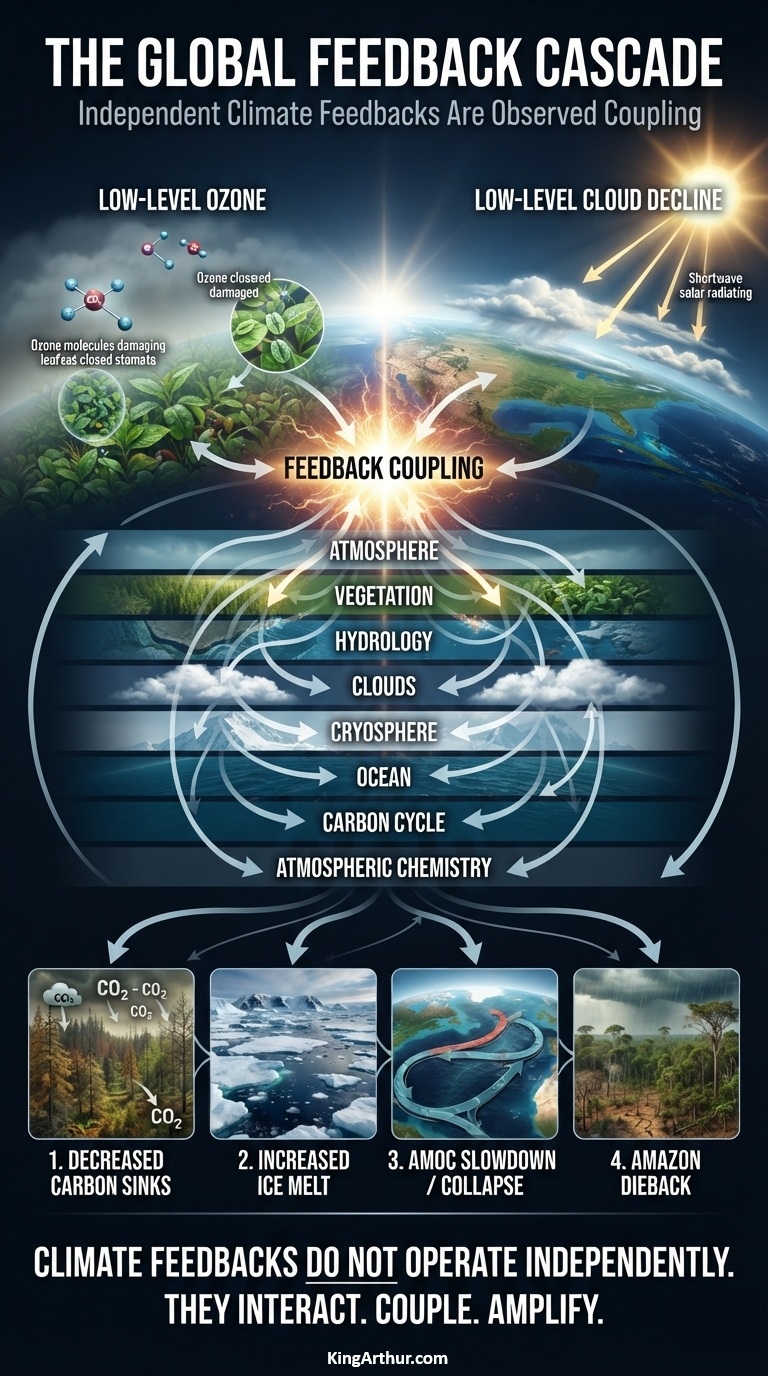
The climate system is not simply warming—it is changing how it responds to that warming. Coupled climate feedbacks are becoming one of the most consequential dimensions of climate risk in the 21st century because they amplify changes and connect individual tipping-point pathways into larger cascading effects.
The longer warming persists, the more climate feedbacks become active. As these feedbacks interact, we are already observing nonlinear responses, amplification, and cascading impacts across the climate system. Hundreds of feedback mechanisms have been identified, and many can couple and reinforce one another, contributing to the accelerating pace and increasing magnitude of climate change—The Domino Effect.
[Intro]
One thing changes…
Pushin’ rearranges
Then they start talking to each other.
That’s when the trouble begins.
(Again and again)
[Refrain]
Feedback
(Get back, back, back)
Coupling
(Sing, sing, sing:)
Here we go!
(Tippin’ like a domino)
Ho! Ho! Ho!
(Fallin’ over… ya know?)
[Verse 1]
One little push can start a sway
One small shift can change the way
Can you see the sea…
(Saw) …
A changing world changes me
(Jaw dropping awe)
[Pre-Chorus]
One!
(Then two!)
Two!
(Then three!)
Linked!
(You see?)
Round!
(And round!)
[Chorus]
Feedback
(Get back, back, back)
Coupling
(Sing, sing, sing)
One turns two
(Two turns three)
What was separate
(Converges aggressively)
Push one piece
(Watch it roll)
Tip one point
(Lose control)
Here we go!
(Tippin’ like a domino)
Ho! Ho! Ho!
(Fallin’ over… ya know?)
[Verse 2]
Increase the beat.. feed the sky
More vapor rising high
Rain can fall, then reign can poor
And carve a different shape ashore
[Bridge]
It’s not one domino
(It’s a chain)
Not one switch
(Not one flame)
One pathway
(Meets another)
One threshold
(Finds another)
Feedback!
(Back again!)
Coupling!
(Join the chain!)
Amplification!
(Feel the gain!)
… or feel the pain?
(No gain all pain)
Cascade!
(Here we go!)
[Rap Vocal Break]
One change
Then a second
Then a third comes through
(Right on top of you)
Dark ground drinks light
Through the day (into the night)
Not isolated
Not alone
The pieces talk
The system’s moan
One domino
Could knock down two
Two hit three
And three hit you
[Breakdown]
Tip…
Tip…
Tip…
Listen…
That’s not collapse.
That’s coupling…
(Toppling…)
Calling…
(Falling)
On top you me
(And you, too)
[Final Refrain]
Feedback
(Get back, back, back)
Coupling
(Sing, sing, sing:)
Here we go!
(Tippin’ like a domino)
Ho! Ho! Ho!
(Fallin’ over… ya know?)
[Final Chorus]
Feedback
(Get back, back, back)
Coupling
(Sing, sing, sing)
One turns two
(Two turns three)
Linked together
(You and me)
Amplify
(Amplify)
Accelerate
(Accelerate)
Tip!
(Tip!)
Cascade!
(Cascade!)
Here we go!
(Tippin’ like a domino)
Ho! Ho! Ho!
(Fallin’ over… ya know?)
[Outro]
One…
Two…
Three…
Tip…
Fall…
Feedback…
Coupling…
[Spoken, fading]
Once they start talking…
(Too late for walking.)
About the Song
Coupled climate feedbacks are becoming one of the most consequential dimensions of climate risk in the 21st century because they amplify changes and connect individual tipping-point pathways into larger cascading effects.
The longer warming persists, the more climate feedbacks become active. As these feedbacks interact, we are already observing nonlinear responses, amplification, and cascading impacts across the climate system. Hundreds of feedback mechanisms have been identified, and many can couple and reinforce one another, contributing to the accelerating pace and increasing magnitude of climate change—The Domino Effect.
[Intro]
Feedback loop and tipping-point network: it starts at the top of the world… and works its way down to Middle Earth, where our girth is actually slowing the planet’s rotation. Welcome to the present.
Starting at the top…
(Top of the world)
Place is changing…
(Things are rearranging)
Down from the poles…
(Into the whole)
A little change
(Becomes something strange)
[Verse 1]
Up where the cold wind blows
(Where the white world glows)
Ice is losing ground
(And the heat comes round)
Pole to pole
(Losing control)
The gradient weakens
(The system awakens)
Difference gets smaller
(The feedback gets taller)
[Pre-Chorus]
Move the mass
(Change the spin)
One more coupling
(Let it begin)
[Refrain]
Starting on top of the world
(Coming unfurled)
Working down to the middle
(Creating an existential riddle)
Are you slowing down
(Spinning round)
Down, down, down
(Hey! Hey! Hey!)
Changing the time of day
[Verse 2]
The equator
(The pole)
Used to have a different role
(For sure)
Hot and cold
(High and low)
Set the gradient
(Watch it go)
That old difference
(Doesn’t last)
Energy moves
(Into different grooves)
And down below
(Feel the water flow)
[Refrain]
Starting on top of the world
(Coming unfurled)
Working down to the middle
(Creating an existential riddle)
Are you slowing down
(Spinning round)
Down, down, down
(Hey! Hey! Hey!)
Changing the time of day
[Verse 3]
Welcome to Middle Earth
(What’s that really worth?)
Our girth
(Has some worth)
Shift the distribution
(Change the rotation)
Tiny little change
The system’s sure strange)
Begin!
(Spin!)
Mass!
(Fast!)
Move!
(Prove!)
Time!
(And time again!)
Top of the world!
(Down to the middle!)
Top of the world!
(Down to the middle!)
[Verse 4]
Atomic clocks
(Watch the rocks)
Earth rotation
(Observation)
A tiny variation
(In the rotation)
Becomes information
(About the whole system)
[Bridge]
One system…
(Many parts)
One pulse…
(Many hearts)
Mass…
(Spin…)
Time…
(Begin!)
A change up there
(Travels down here)
A change over there
(Alter what’s near)
Amplification!
(Redistribution!)
Mass!
(Rearrangement!)
Inertia!
(Yeah, yeah, yeah!)
Introspection
(Rotation!)
Hey!
(Hey!)
Hey!
(Hey!)
HEY!
[Refrain]
Starting on top of the world
(Coming unfurled)
Working down to the middle
(Creating an existential riddle)
Are you slowing down
(Spinning round)
Down, down, down
(Hey! Hey! Hey!)
Changing the time of day
Starting on top of the world
(Coming unfurled)
Working down to the middle
(Find a piece of the riddle)
Are you slowing down
(Spinning round)
Down, down, down
(Hey! Hey! Hey!)
Changing the time of day
[Final Refrain]
Starting on top of the world
(Coming unfurled)
Working down to the middle
(Creating an existential riddle)
[Outro]
Are you slowing down
(Spinning round)
Down, down, down
(Hey! Hey! Hey!)
Changing the time of day
Starting at the top…
(Down to the middle)
Feedback coupling…
(It’s all connected)
Round and round…
(The network’s turning)
Day by day…
(Time keeps changing)
Round and round…
(Down, down, down…)
Hey! Hey! Hey!
(The time of day)
About the Song
Feedback loop and tipping-point network: it starts at the top of the world… and works its way down to Middle Earth, where our girth is actually slowing the planet’s rotation. Welcome to the present.
Polar amplification → weakened equator-to-pole temperature gradients → planetary mass redistribution → altered moment of inertia → rotational dynamics → slight rotational slowing → changes in length of day.
→ Feedback Loop and Tipping-Point Network
About the Song
Feedback loop and tipping-point network: it starts at the top of the world… and works its way down to Middle Earth, where our girth is actually slowing the planet’s rotation. Welcome to the present.
Polar amplification → weakened equator-to-pole temperature gradients → planetary mass redistribution → altered moment of inertia → rotational dynamics → slight rotational slowing → changes in length of day.
Today’s new release, “Feedback Network,” is also tonight’s homework assignment: create a theme-song sound for the next eco-rock album, “Feedback Coupling.”
The song is about a remarkably strange consequence of climate change: humanity is, in a very literal sense, changing the length of the day.
As polar ice melts and mass is redistributed through the Earth system, the planet’s rotation can change slightly. The effect is tiny—but measurable, and large enough to create challenges for keeping highly precise time in scientific and technical applications.
It’s a little like the Y2K problem of 1999. Y2K involved a seemingly tiny detail in computer code—the way years were represented—that became important because modern systems depended on precise timekeeping.
This is different, of course. Here, the problem isn’t a coding convention. It’s the Earth itself changing how it rotates.
And that matters for systems that depend on extremely precise timing and positioning—particularly GPS and other satellite-based technologies.
The irony is pretty remarkable:
We changed the climate.
The climate changed the planet.
And now we’re having to account for the change in the clock.
This song is my attempt to translate that feedback network into sound.
It’s experimental audio science.
The track begins with a clean acoustic/electric guitar signal, running through a digital delay and distortion pedal. The guitar starts relatively clean and acoustic. Then the distortion enters, followed by increasing digital-delay feedback.
Next, a live synthesizer joins the network.
Again, the signal begins clean.
Then it becomes distorted.
Then delayed.
Then the delay feeds back into itself.
And the guitar and synth begin interacting as a coupled system.
Clean signal → distortion → delay → feedback → synth → distortion → delay → feedback.
The musical system starts behaving a little like the climate system I’m trying to describe: one change feeds into another, which feeds back into the first, creating something larger and increasingly complex.
By the end, we’ve arrived at some serious feedback coupling.
Welcome to “Feedback Network.”
And welcome to “Feedback Coupling.”
[Intro]
Low and behold…
There’s a fine line…
A number is told
As the story unfolds…
[Verse 1]
One point four
Then one point five
Nothing magical
Keeps us alive
A threshold ain’t
A brick wall
It’s a place
Where the odds change “over all”
A warning line
In a moving game
The situation changes
But the stakes ain’t the same
[Pre-Chorus]
One more chance
One last glance
One more dance
The wire is waiting
Hidden from view
You don’t know exactly
What it will do to you
[Refrain]
Low and behold…
(… through…)
… the threshold…
Trip (trip) tripin’
(Over the wire)
Trippin’…
(Into the dire)
[Verse 2]
Surprisingly…
Ain’t a magic door
Where everything suddenly
Gets worse than before
It’s probability
Stacked in the air
Feedbacks awakening
Everywhere
[Refrain]
Low and behold…
(… through…)
… the threshold…
Trip (trip) tripin’
(Over the wire)
Trippin’…
(Into the dire)
[Bridge]
One tripwire…
slight time transpire…
… tripwire…
(Wrapped in barbwire)
You thought there’d be
A warning light
A siren
A flashing sign
Surprise?
(Open your eyes)
Nothing new (knew)
All your fears…
(Have been known for years)
[Instrumental]
So don’t ask me
(If you can see)
The scene (is seen)
[Refrain]
Low and behold…
(… through…)
… the threshold…
Trip (trip) tripin’
(Over the wire)
Trippin’…
(Into the dire)
[Outro]
Low and behold…
(… probability)
The threshold…
Trip (trip) tripin’
(Over the wire)
Trippin’…
(Into the dire)
One point five…
(Still alive)
One point five…
(Now try to survive…)
Trip (trip) trippin’
… the tripwire…
Tripwire…
… wire…
… wire…
… dire…
About the Song
The 1.5°C threshold identified in the Paris Agreement—and the roughly 2°C level generally regarded as an even more dangerous boundary—is not important because the difference between 1.4°C and 1.5°C is somehow magical. These numbers matter because increasing global temperatures raise the probability of triggering major climate tipping points.
And once tipping points begin to activate, the question of whether warming ultimately reaches 2°C, 3°C, or even 4–7°C becomes much less relevant for two fundamental reasons:
First, tipping points can initiate self-reinforcing feedbacks that continue driving change even after the original forcing changes.
Second, the impacts do not necessarily increase gradually with temperature. They can accelerate, compound, and cascade as interconnected systems begin to destabilize.
In other words, 1.5°C is not a destination. It is not merely a warning sign or an alarm. It is a tripwire.
[Intro]
Surprise!
(Hitting ya in the eyes)
Blinding
(Reign, rain)
Pouring
(Poor poor)
Surprise!
(Hitting ya in the “realize”)
[Refrain]
Blinding
(Reign, rain)
Pouring
(Poor poor)
Blinding reign
(Pouring poor)
The rule of man
(Command of the fool)
Burning their house down
(Down, down, down)
Surprise!
(Hitting ya in the eyes)
Realize?
(Hitting ya in the eyes)
Recognize…
(And open your eyes…)
[Refrain]
Blinding
(Reign, rain)
Pouring
(Poor poor)
Blinding reign
(Pouring poor)
The rule of man
(Command of the fool)
[Outro]
Burning their house down
(Down, down, down)
Surprise!
(Hitting ya in the eyes)
Blinding
(Reign, rain)
Pouring
(Poor poor)
See the scene seen?
About the Song
What happens to you over the next five years?
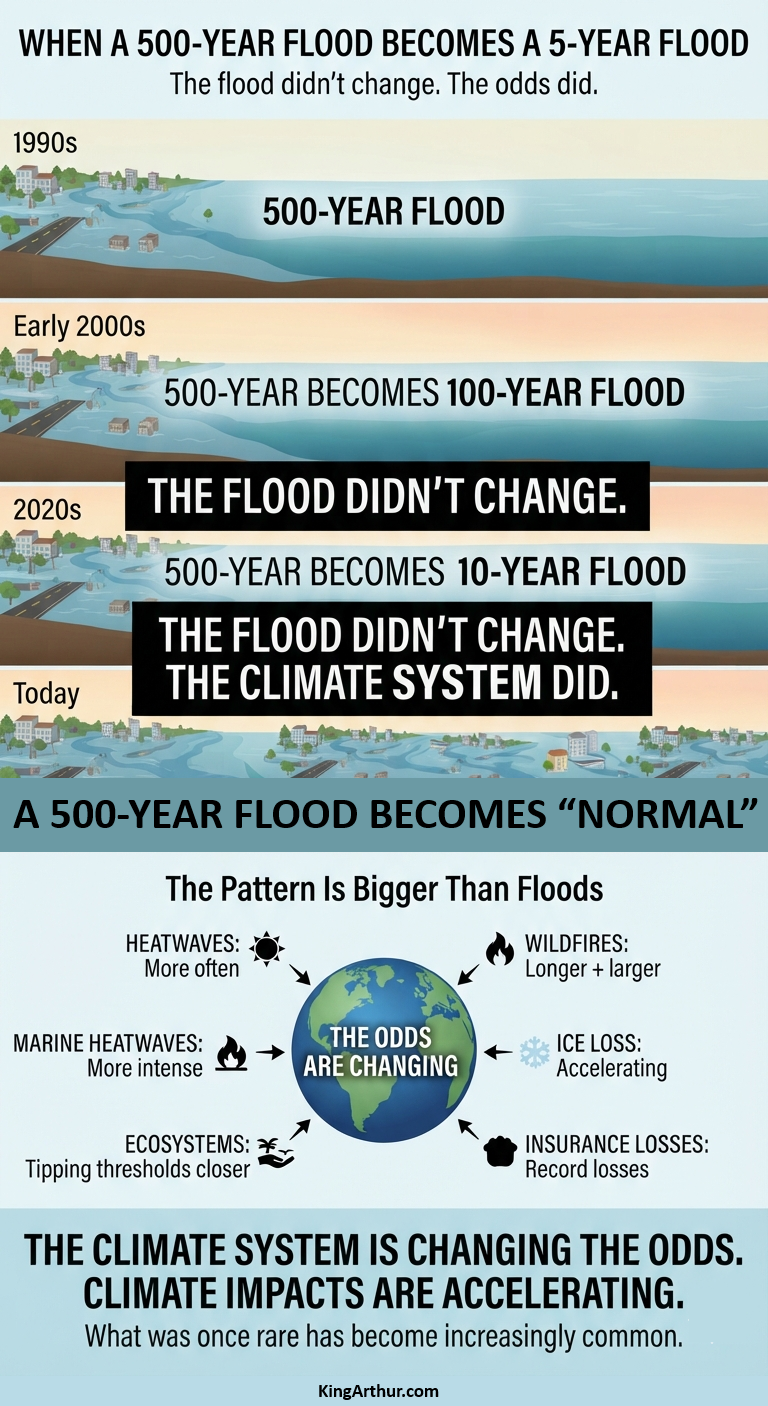
We are already seeing rainfall becoming more intense and, in many places, more destructive—violent. A warmer atmosphere can hold more water vapor, increasing the potential for extreme precipitation. The question isn’t simply how hot the planet might become over the next 50 years.
The more immediate question is:
What is the violent rain going to do to your home, your community, your infrastructure, your insurance—and you—over the next five years?
That is where climate change stops being a distant projection and starts becoming a personal reality.
Welcome to the future. Climate change is accelerating—and the acceleration itself is accelerating.
Many people equate global warming solely with increasing temperatures. This is a deadly misunderstanding. The additional energy accumulating within Earth’s climate system does not remain simply as heat. It is redistributed throughout the atmosphere and oceans, manifesting in many forms of extreme weather, including floods, stronger storms, atmospheric rivers, and increasingly destructive episodes of violent rain.
Violent rain is not merely heavier rainfall. It is rainfall intensified by the additional energy and moisture now present in the climate system, producing larger raindrops, higher rainfall rates, more intense runoff, and more destructive flooding and erosion.
Multiple factors drive the physics of violent rain, beginning with the moisture content of the atmosphere.
As the Earth warms, warmer air can physically hold more water vapor than cooler air. For every 1°C (1.8°F) increase in temperature, the atmosphere can hold approximately 7% more moisture, increasing the potential for extreme precipitation. Over a 10°C increase, atmospheric moisture capacity nearly doubles, dramatically amplifying the intensity and frequency of heavy rainfall events.